Pope Francis laid to rest after historic funeral | Eyewitness News updates

WABC logo
Last updated: Saturday, April 26, 2025 8:49PM GMT
Pope Francis laid to rest in historic funeral amongst world dignitaries, Catholic faithful

NEW YORK (WABC) -- World dignitaries and Catholic faithful attended Pope Francis' funeral in St. Peter's Square on Saturday.

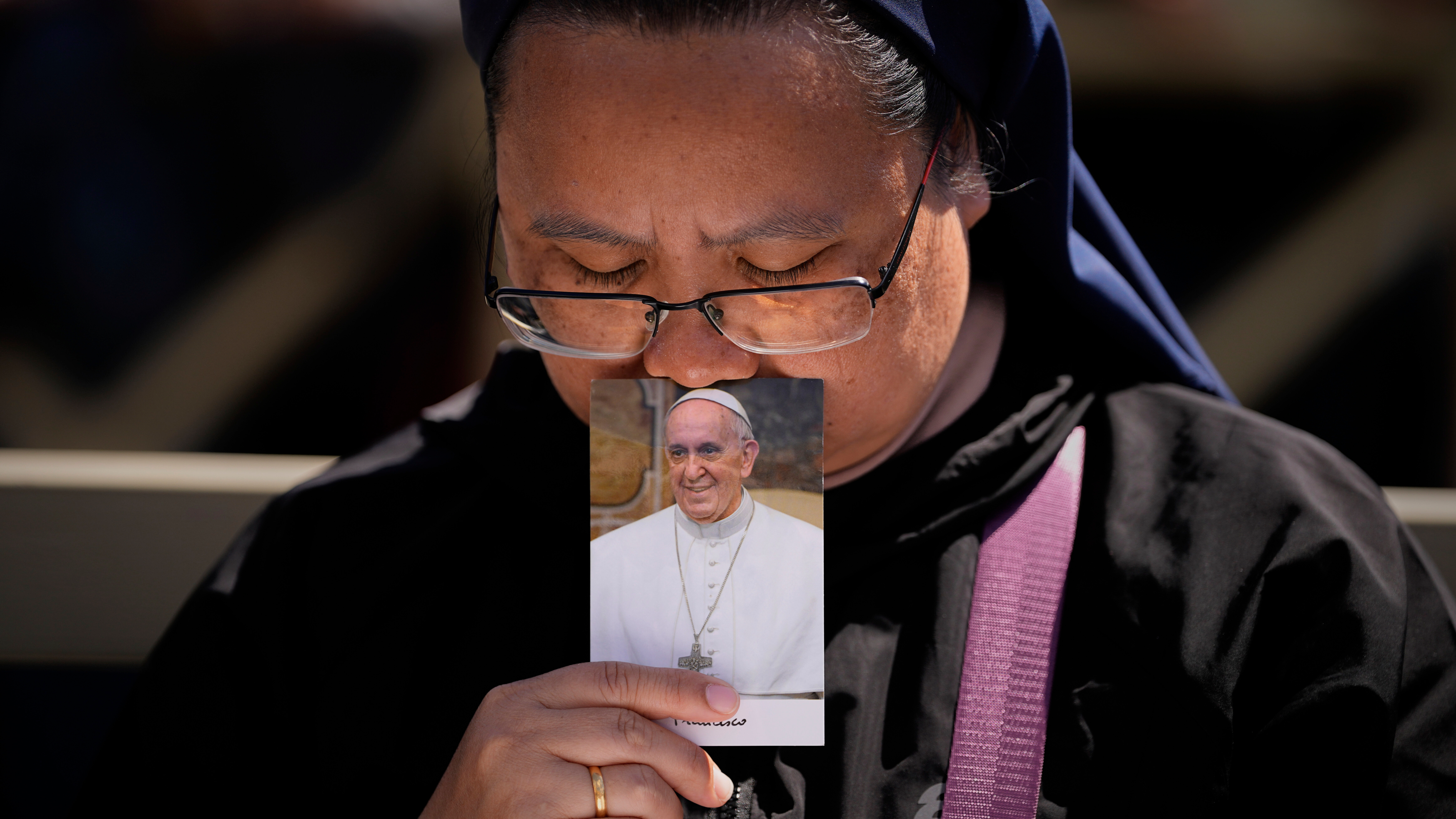
Despite the presence of presidents and princes, prisoners and migrants ushered him into the basilica where he will be buried, reflecting his priorities as pope, as hundreds of thousands have flocked to the funeral Mass.

U.S. President Donald Trump, French President Emmanuel Macron, the U.N. chief and European Union leaders, as well as Prince William and the Spanish royal family, were in attendance.

Francis is breaking with recent tradition to be buried in the St. Mary Major Basilica in a simple underground tomb with just his name: Franciscus.

Argentinian-born Jorge Mario Bergoglio became the Catholic Church's 266th pope and the first ever from Latin America. He took the name Francis after the well-known St. Francis of Assisi, who ministered to the poor.

Pope Francis died on Easter Monday at the age of 88 after suffering a stroke, setting off mourning in the Catholic world and days of ritual at the Vatican.

1 of 28
The coffin of Pope Francis arrives at St. Mary Major Basilica for his burial ceremony, in Rome, Saturday, April 26, 2025.
AP Photo/Antonietta Baldassarre

ABCNews logo
Apr 21, 2025, 2:58 PM GMT

Popes through the ages: Some facts you might not know

Who was the very first pope? How many popes have there been? Has anyone ever refused the office?

For an institution that has existed for nearly 2,000 years, most people know very little about the papacy and its history. Here are some of the most commonly asked questions and a few answers you may find surprising.

Click here for more.

Apr 21, 2025, 2:48 PM GMT

Which cardinals are seen as contenders to be the next pope?

A popular saying in Vatican circles is that if you "enter a conclave as pope, you leave as a cardinal." It implies the sacred and secretive process is no popularity contest or campaign, but rather the divinely inspired election of Christ's Vicar on Earth by the princes of the church.

Still, there are always front-runners, known as "papabile," who have at least some of the qualities considered necessary to be pope - much like those depicted in last year's Oscar-nominated film "Conclave."

Any baptized Catholic male is eligible, though only cardinals have been selected since 1378. The winner must receive at least two-thirds of the vote from those cardinals under age 80 and thus eligible to participate. Pope Francis, who died Monday, appointed the vast majority of electors, often tapping men who share his pastoral priorities, which suggests continuity rather than rupture.

Click here to learn more about some possible candidates.

Apr 21, 2025, 2:38 PM GMT

Electing a new pope: What happens next and what is a papal conclave?

The process by which a new pope is elected has undergone numerous changes in the nearly two millennia that the Catholic Church has existed, with the current procedure a combination of ancient traditions and modern updates as recent as 2013, reflecting changes instituted by Pope Benedict XVI. Even so, the essential ritual has remained largely unchanged for centuries.

Pope Francis' death sets into motion a series of formalized rites and observances that occur during what is called the interregnum, which begins upon the pontiff's passing and ends with the election of his successor. The period of time during which the papacy is vacant is known as the sede vacante, Latin for "vacant seat."

The pope's death is first ritually verified by the cardinal camerlengo, or chamberlain, who who runs the ordinary affairs of the Vatican city-state during the sede vacante. A traditional nine days of mourning then commences. This includes the pope's funeral, which per tradition is held within four to six days of his death, after his body lies in state for several days in St. Peter's Basilica. This also allows global dignitaries and heads of state to pay their respects and attend the funeral.

It's also during the interregnum that all cardinals under the age of 80 who are eligible to participate are summoned to Rome to prepare for the secret conclave inside the Sistine Chapel to choose the next pontiff, a gathering that typically commences between 15 to 20 days after the pope's death. The cardinals spend the interregnum housed in private rooms in the Domus Marthae Sanctae -- essentially a residence hotel in the Vatican with dining facilities that usually houses visiting clergy and laity. Per tradition, the cardinals are cut off from the outside world, including televisions, phones, computers and newspapers.

The College of Cardinals will cast as many as four ballots in a single day for the next pope, with a two-thirds majority required to elect a pontiff. After each vote, the ballots are burned and smoke is released from the Sistine Chapel's chimney as a signal to the throngs holding vigil in St. Peter's Square. Black smoke -- fumata nera in Italian -- indicates an inconclusive vote, while white smoke -- fumata bianca -- will signify that a new pope has been elected. If three days pass with no pope elected, voting can be suspended for a day to allow the cardinals time for reflection before the next round of ballots are cast.

Once the College of Cardinals elects a new pope, the candidate is formally asked in the Sistine Chapel if he accepts the election and, if so, to choose his papal name. While popes have the option of keeping their baptismal name, every pope for the last 470 years has chosen to change his name, usually to honor a predecessor and to signal their intention to emulate his example.

The interregnum ends when the newly elected pope makes his first public appearance in his new role, stepping onto the central balcony at St. Peter's Basilica, overlooking St. Peter's Square, to bless the gathered crowd there after being introduced by the senior cardinal deacon with the traditional declaration "Habemus papum" Latin for "We have a pope."

Apr 21, 2025, 2:40 PM GMT

Pope Francis, everyman leader of the Roman Catholic Church, dies at 88

Pope Francis, whose time as head of the Catholic Church was noted for an everyman humility and outreach efforts to people of disparate backgrounds and faiths, has died at 88, the Vatican has confirmed.

Pope Francis was hospitalized for just over five weeks beginning in February 2025 to address what the Vatican initially said was a respiratory tract infection, for which he began receiving treatment. Four days after his hospitalization, the Vatican revealed that Francis had been diagnosed with bilateral pneumonia.

Pope Francis was released from the hospital and returned to the Vatican on March 23, where his physicians said he would require additional months of recovery. Two weeks later, he made his first public appearance since his discharge from the hospital, sitting in a wheelchair while using supplemental oxygen as he briefly greeted people in St. Peter's Square. He also made an appearance on Easter Sunday from the balcony of St. Peter's Basilica, following a earlier meeting with Vice President JD Vance.

Click here for the full story.