The on-court trends defining the 2026 NBA playoffs

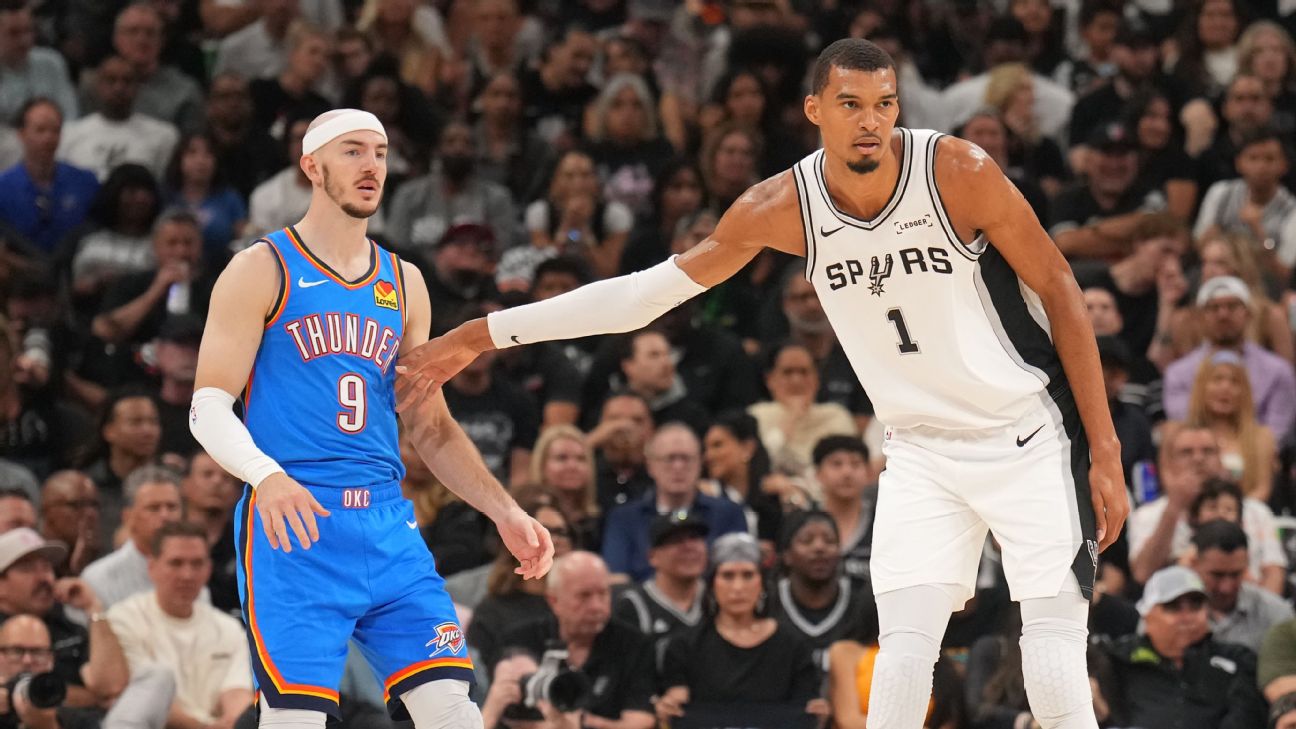
The 2026 NBA conference finals are approaching their climax on one side of the bracket and fizzling out in the other.
Out West, the Oklahoma City Thunder and San Antonio Spurs are fulfilling expectations of a classic, with a 2-2 tie entering Tuesday's Game 5 (8:30 p.m. ET, NBC). Meanwhile in the Eastern Conference, the New York Knicks completed a four-game sweep over the Cleveland Cavaliers on Monday to reach the NBA Finals for the first time since 1999.
Let's take stock of six key trends and takeaways for the final four teams, as the 2025-26 NBA season enters its final month. I'll start in San Antonio, with the MVP of the playoffs to this point.
Jump to a section:
Wemby is MVP | Caruso's legacy | Knicks' starters
Knicks' luck | Cavs can't score | Gotta have Hart

Victor Wembanyama is the playoff MVP (so far)
It's far from clear whether the Spurs will pull off the upset of the defending champs and advance to the Finals. But it's very clear that Wembanyama has been the best and most valuable player this postseason.
Even though he left two games very early, due to an injury and ejection, Wembanyama is still averaging 23.1 points, 11.4 rebounds and 3.8 blocks per game in the playoffs. He's making 37% of his 3-pointers and 86% of his free throws. And the Spurs have a plus-17.3 net rating with him on the court, versus a minus-0.3 net rating without him.
In the conference finals, that gap is even starker: a plus-6.1 net rating with Wembanyama but an astonishing minus-60.3 without him.
In advanced stats, Wembanyama ranks first among all players in the playoffs in ESPN's net points metric. He's first in estimated plus-minus. And he's second in box plus-minus, behind only Karl-Anthony Towns.
It's difficult to say whether Towns has even been the most valuable player on his own team this spring. Jalen Brunson, Towns and OG Anunoby rank second, third and fourth, respectively, on the playoff net points leaderboard.
But Wembanyama is clearly the top Spur, with almost as many net points in the playoffs as the second-, third- and fourth-most-valuable Spurs (Dylan Harper, Stephon Castle and Julian Champagnie) combined.
That's quite a showing for a 22-year-old in his first postseason. But it's just one more way that Wembanyama is unlike anything the NBA has seen before.
Alex Caruso is burnishing his legacy
Caruso has arguably been Oklahoma City's best player in the conference finals. Like the rest of his teammates, he was lousy in Game 4, but he averaged 21 PPG while making 61% of his 3-pointers through the first three games, throwing a wrench in the Spurs' plans to leave him open on the perimeter. His plus-minus through the first three games (plus-15.3 points per game) was tied for the best mark on the team.
Those offensive boosts are secondary to Caruso's regular contributions on the other end, as he's one of the best and most versatile defenders in the NBA. According to estimated plus-minus, Caruso is currently the NBA's fourth-most-valuable defender on a per-possession basis, behind Wembanyama, Ausar Thompson and Rudy Gobert. According to xRAPM, he's second behind Wembanyama.
Emphasizing his versatility, Caruso's most frequent defensive matchups in the past couple of rounds, per GeniusIQ, are against LeBron James, Wembanyama and Stephon Castle: a forward, center and guard, all three of them physical outliers with very different skill sets. And Caruso can guard each of them.
It's difficult to think of a good historical precedent for Caruso, a two-time champion with the Thunder and Lakers. He's a unique player. But I set three criteria to try to come up with some comps. First, the player has to have at least two titles while playing at least 15 minutes per game in those postseasons. Second, those titles have to come with multiple franchises. And third, the player has to be a zero-time All-Star, to emphasize the true nature of a role player.
Those don't seem like particularly prohibitive benchmarks, yet they produce a select list: In addition to Caruso, only Robert Horry (seven championships), Ron Harper (four), Danny Green (three), Mario Elie (three), Kentavious Caldwell-Pope (two), James Posey (two) and Charles Johnson (two) fit those criteria.
And Caruso is even more special because of one extra step: He's come off the bench in each of his title runs. In contrast, Harper, Green, Elie, Caldwell-Pope and Johnson started for at least half of their championship campaigns, which leaves only Caruso, Horry and Posey in this final select class of multiteam championship reserves.
Horry deserved his reputation, not only because of his clutch 3-pointers -- of which there were many -- but because of his overall playoff production. His career box plus/minus rose from plus-1.9 in the regular season to plus-3.7 in the playoffs. Posey's BPM rose by even more, from plus-0.3 in the regular season to plus-3.2 in the playoffs.
Similarly, Caruso's BPM rises from plus-1.1 in the regular season to plus-2.6 in the playoffs. And in Oklahoma City, his playing time has increased from 18.9 minutes per game in the regular season (while missing 33% of games) to 23.6 in the playoffs (while missing zero games).
Horry is still on another level in terms of ultimate team success, with seven titles across three franchises. But Caruso is in the same mold -- a so-called "playoff riser" in the truest sense.
The Knicks are starting strong
When the Knicks traded for Towns and Mikal Bridges in the summer of 2024, adding that duo to the incumbent trio of Brunson, Anunoby and Josh Hart, they seemed to be constructing a perfectly balanced modern starting five. On paper, at least, New York's new main lineup could score at all three levels, shoot the lights out and defend the perimeter at an elite level.
Yet for two years, that group never clicked in practice like it did in theory. Last season, the Knicks' starting five had a mere plus-3.3 net rating, and this season, they were at plus-2.3, which ranked 16th out of 19 units with at least 200 minutes.
In the playoffs last season, this Knicks quintet was outscored by 6.2 points per 100 possessions, even as the franchise reached the conference finals for the first time in a quarter-century.
But with Towns and Anunoby playing the best playoff basketball of their careers, Bridges reaching a new level, and Hart and Brunson embracing their typical roles, the Knicks' starters are finally living up to their potential as a group.
During New York's 10-game winning streak, through Game 2 of the conference finals, this fivesome had a plus-15.2 net rating. Its 123.0 offensive rating in that span would have led the league in the regular season, and its 107.8 defensive rating would have ranked second.
The Knicks' various bench permutations -- slotting in the likes of Miles McBride, Landry Shamet and Mitchell Robinson for a starter or two -- are winning their minutes by an even greater margin. But the starters are finally rolling in big minutes; they lead all five-man lineups in minutes this postseason, even though Anunoby missed two games. That's a recipe for historic dominance.
The basketball gods might be Knicks fans, too
Amid all the other factors behind their historic success this spring, the Knicks are also benefiting from that old small-sample culprit: shooting luck.
Through Game 3 of the conference finals, Knicks opponents made just 32.0% of their wide-open 3-pointers (with the closest defender at least 6 feet away) this postseason, per GeniusIQ. That's the lowest percentage for any conference finalist in the tracking era (since 2013-14).
Opponents' wide-open 3-point percentage in playoffs
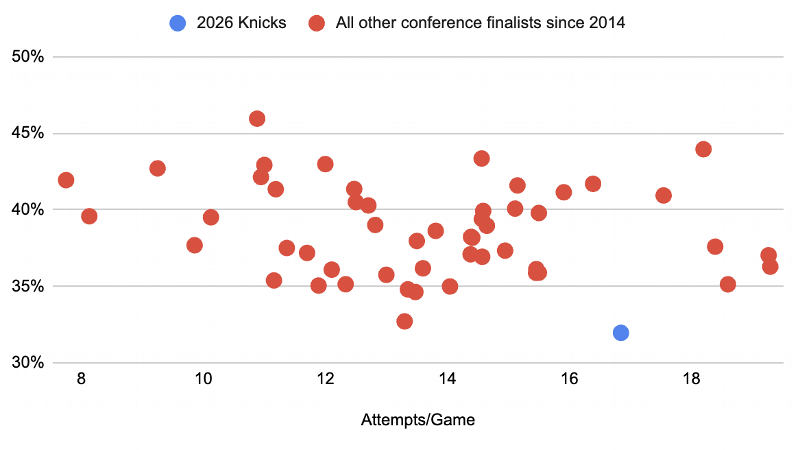
This is an unusual statistical finding. In the regular season, the Knicks' opponents made 37.8% of their wide-open 3s. The overall playoff average this year is also 37.8%. And the quantified shot probability for Knicks opponents on wide-open 3s -- in other words, the amount they would expect to make, based on factors such as shooter identity and shot location -- is 38.1%.
By any measure, then, the Knicks have been incredibly lucky that the Toronto Raptors, Philadelphia 76ers and Cavaliers have missed so many 3s.
To be clear, that luck is not the main reason for their success. Shot quality data suggests the Knicks "should have" allowed about 40 more points on wide-open 3s than they actually have in this playoff run. That's a lot, but it's nowhere near their plus-234 scoring margin overall.
Yet in the Finals, the Knicks likely won't be able to rely on this trend persisting. They can't expect their opponents to continue missing so many wide-open looks they normally make.
The Cavaliers have a scoring problem
Earlier this postseason, I wrote about how the Nuggets' playoff struggles could be largely ascribed to their offense, despite so much attention going to their statistically inferior defense.
The same counterintuitive pattern applies to Cleveland. Despite all the analysis of the Cavaliers' 15th-ranked defense and its various matchup foibles -- from James Harden's one-on-one defense against Jalen Brunson to Cleveland's efforts against the non-Cade Cunningham Pistons -- seemingly nothing on that side of the ball actually mattered this postseason.
Rather, Cleveland's game-by-game results were dictated entirely by its sixth-ranked offense. In the Cavaliers' eight playoff wins, their offensive rating was 116.2 or better. And in their nine playoff losses, their offensive rating was 110.2 or worse.
All teams naturally tend to score more points in their wins than in their losses. But the relationship isn't usually so clear-cut as the one the Cavaliers have had. The Spurs, for instance, had a worse offensive rating in Games 1 and 4 of the conference finals, which they won, than in Games 2 and 3, which they lost.
For Cleveland, though, the relationship was direct and one-to-one. If they scored at an above-average rate, they won; if they scored like a bottom-of-the-league offense, they lost.
For a team built around two offensively gifted guards, in Donovan Mitchell and James Harden, that split is just not good enough. Part of the problem is that Cleveland's 3-point shooters went cold at the wrong time, but Mitchell and Harden also weren't consistent or efficient enough this postseason.
The result is a team that reached the conference finals for the first time without LeBron James since 1992, but still managed to amass a losing record in the playoffs, and now faces big thorny questions this offseason.
Full Hart(enstein)s, can't lose
It's fairly common for role players to be played off the court in the postseason, due to individual weaknesses that magnify in the playoff crucible. It's the "can't play Kanter" problem -- a big man isn't agile enough to defend pick-and-rolls, or a wing's shaky jumper means opposing defenses leave him open, or a guard isn't big enough to avoid being targeted.
It's not easy to fill a rotation with players who lack such weaknesses, so it's all the more important for a contender's role players to stay on the right side of that border. That positive outcome has occurred for both New York and Oklahoma City in the conference finals.
For the Knicks, Hart was benched in the fourth quarter and overtime of Game 1, as the Cavaliers didn't guard him on the perimeter and instead mucked up his teammates' driving lanes. New York had a minus-23 scoring margin in his 31 minutes, versus a plus-34 margin in 22 minutes without him.
But Hart rebounded in Game 2, leading all players with 26 points and five 3-pointers. New York was plus-18 with him on the floor. And he was solid enough to play 35 more minutes in Game 3.
Similarly, in Oklahoma City, center Isaiah Hartenstein was benched just two minutes into Game 1 due to a seemingly inopportune matchup against Wembanyama; he ended up playing just 12 minutes that night, almost all of them against the Spurs' backup units.
But Thunder coach Mark Daigneault changed tact in Game 2, instead making Hartenstein the primary defender on Wembanyama, with the aim of leveraging Hartenstein's size and physicality against the San Antonio center. Hartenstein scored 10 points and grabbed 13 rebounds (eight offensive) in 27 minutes in Game 2, then played 21 more minutes in a Game 3 win and was one of the only Thunder players who had a decent individual night in Game 4.
Hart and Hartenstein's ability to stay on the court despite their imperfections gives their teams more options and versatility, which could prove critical as their playoff journeys continue. The NBA is a star's league, and the likes of Brunson and Shai Gilgeous-Alexander will always be the Finals MVP favorites. But especially in this era of parity, it takes a whole team to win a title.
]