Inside a Knicks celebration a half-century in the making

SANDRA BRUNSON KNEW she was taking a risk by flying commercial to Game 5 of the NBA Finals in San Antonio, instead of taking the team's charter from New York. But over the years, her family's tolerance for risk has risen.
There was the original risk she took in marrying the basketball player she'd fallen in love with in college, signing up for a life tied to his ability to make the NBA or stick with a team for any length of time.
There was the risk of having their first child by herself while her husband, current Knicks assistant coach Rick Brunson, was playing professional basketball in Australia.
And then, of course, there was the risk of allowing that first-born son to follow in his father's footsteps and pursue a career in basketball, knowing how hard and unpredictable the road could be.
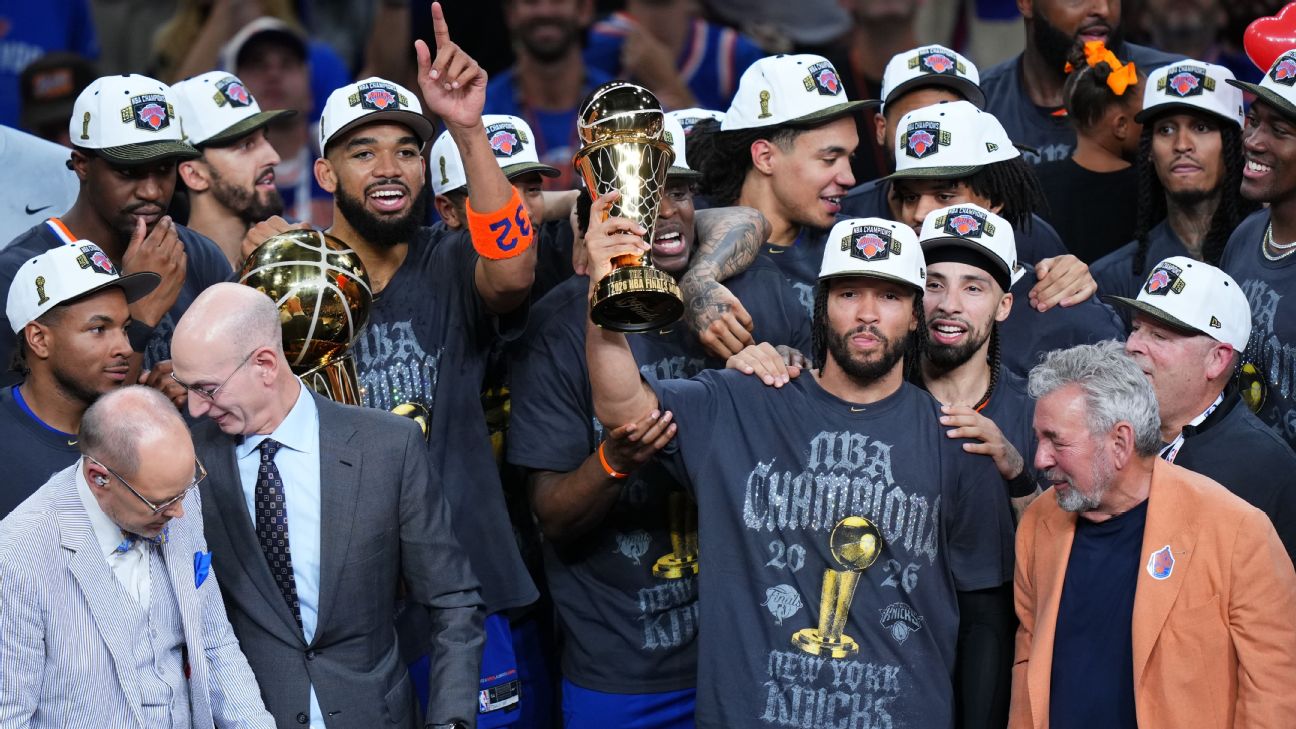
But as she stood in the tunnel of San Antonio's Frost Bank Center on Saturday night, watching as her son Jalen walked by holding the Larry O'Brien Trophy he'd just won as the captain of the New York Knicks, Sandra Brunson said she never really saw any of it as a risk at all.
"All I can say is it's about belief," she said. "I remember asking Jalen during his junior year of college if there was one word that he would use to encompass everything he's about. He said, 'Belief.'"
Belief that if he worked hard enough it would lead to a night like Saturday, when the Knicks beat the San Antonio Spurs 94-90 to capture the franchise's first title since 1973.
Belief that his will was enough to lead a team back from any deficit -- even historic 29-point deficits -- which he did in all four of the Knicks' wins this series.
Belief that championship teams are built, identities are cast in stone, step by step, by a group of men believing in each other and supporting each other, no matter what tests they might face or what outside noise they might hear.
For decades, the Knicks tried and failed to do the opposite -- by chasing superstars and home runs and quick fixes, by changing courses emotionally and erratically.
Which is why this title still feels so surprising despite New York's dominant 16-3 run through the postseason and best margin of victory in NBA postseason history (plus-263).
These Knicks were built on belief, not big swings.
Before each game, Sandra Brunson sends her son a text message with a Bible verse.
She sent one Saturday morning as she boarded an American Airlines flight from Chicago to Austin, Texas. She'd missed her connection in Chicago the night before after one of the pilots on her flight from Philadelphia was late in arriving. She'd taken the risk to fly commercially because she wanted to attend a previously scheduled event for her and Jalen's Second Round Foundation, which took children from Harlem to Philadelphia.
But just like her son, Sandra Brunson is not deterred by setbacks, even small ones like missing a connecting flight and having to drive an hour-and-a-half from Austin to San Antonio the afternoon of the game. She believed she'd arrive in time and she did.
The Bible verse she picked out to both inspire and ground her son on Saturday reflected that.
When you go through deep waters, I WILL BE WITH YOU.
When you go through rivers of difficulty, YOU WILL NOT DROWN.
Isaiah 43:2.
THE MAN WHO believed in Sandra Brunson's husband and son celebrated with his own family in a quiet, nondescript room off to the side of the Knicks' locker room.
Rick Brunson was Knicks president Leon Rose's first client back in 1995. It was not exactly an auspicious beginning for either of them.
Brunson's first agent had ghosted him after he wasn't drafted coming out of Temple University, and Rose was the only agent who still had an interest in representing him.
Rose had largely given up on his dream of being a basketball coach by then. He'd been a scrappy point guard for Division III Dickinson College and gone to law school as a fallback plan because making a living off the whims of 16-18-year-old kids wasn't exactly stable work. But he wasn't ready to leave the game behind.
Rose had coached a high school team while he was in law school in the 1980s. He had hung around the Temple program and built a relationship and respect with legendary coach John Chaney. He'd coached at Rutgers-Camden, even as he began his career as a prosecutor in New Jersey.
But being in private practice demanded more of his time, and Rose had begun to let go of the game. Just when he was almost fully out, basketball reeled him back in.
Lionel Simmons was a great player for LaSalle University who was drafted by the Sacramento Kings in the top 10 of the 1990 draft. Simmons' uncle was his agent and hired Rose's firm for legal representation.
Five years later, Rick Brunson asked him to be his agent.
It took Rose three years to get Rick Brunson a job in the NBA, and he never got Brunson a contract longer than one year. Rose never made much in commissions representing Brunson, whose career earnings over nine NBA seasons totaled $4,682,000.
But Rose stuck with him. Kept getting him coaching jobs after he couldn't play anymore, and finally hired him to be an assistant coach with the Knicks once he became the team's president.
Rose believed in Rick's son, Jalen, even more.
One of his first big moves as Knicks president was to create enough salary cap space to sign Jalen away from the Dallas Mavericks as a free agent in 2022 -- awarding him a four-year, $104 million contract that was widely criticized as an overpay for an unproven, scrappy guard at the time.
"I remember saying to Jalen when they made the offer, 'You can bet on yourself now. They believe in you,'" Sandra Brunson said. "It makes such a difference when people really want you and believe in you."
Sandra had lived enough of her life in New York City to know what her son was signing up for. How long the Knicks had gone without winning a championship and how deeply the fanbase, despite their team's long history of misfires and dysfunction, still cared.
On May 23, before Game 3 of the Eastern Conference finals, she sent her son another message.
Good luck tonight son!
Maintain the same focus and discipline you've displayed throughout. Your basketball IQ is second to none.
Keep making it about your teammates as your opponent focuses on you.
I believe.
Love,
Mom
That night, her son scored a game-high 30 points and led his team to an insurmountable 3-0 series lead.
"People in New York were always saying they needed a star," she said. "And I used to wonder, 'How do you become a star?' You have to give him a chance, right? A chance to actually become a star."
Four years ago, the Knicks believed enough in Jalen to give him that chance. It would be up to him to take advantage of it.
WHEN KNICKS OWNER James Dolan called Rose in 2020 and asked if he would consider running the Knicks, more than one person told Rose he would be crazy to even consider it.
So many basketball luminaries had tried and failed to build a winner in New York, which had only one playoff series win since 2000. So many coaches and executives and players had melted under the enormous pressure. Why did Rose think he could succeed when one of the greatest coaches in NBA history, Phil Jackson, had just flopped in the same job?
His joke, whenever people would ask him why he was doing it, was just to say that if it didn't work out he'd be like every other guy who'd tried and failed. There was no shame in that. But if it worked, the Cherry Hill, New Jersey native said, it would be the greatest thing ever.
The truth is, Rose didn't know if he would succeed. He just wanted to try. He'd grown up in suburban New Jersey with loyalties split between New York and Philadelphia teams.
Rose loved the Knicks teams of the 1970s and watched them win titles in 1970 and 1973. He'd cheered on Joe Namath and the New York Jets in Super Bowl III in 1969.
But when he went shopping for basketball shoes as a teenager, the shoe he had to have was Philadelphia 76ers star Julius Erving's.
And the only place young Rose could get a pair of Dr. J's back then was at Pro Sports in Cherry Hill, where he met a young shoe salesman named William Wesley.
Wesley was only about 13 or 14 back then. But he was an incredible salesman. He'd moved truckloads of early-generation Nike shoes, catching the attention of both Nike executives and professional athletes who came to rely on him for hard-to-find models and sizes.
Wesley went on to become one of the most connected and influential power brokers in sports, earning the nickname, Worldwide Wes. Rose went on to become one of the most powerful agents in basketball. They did some of the biggest deals in basketball history together -- many of them involving the Knicks.
Remember LeBron James' "Decision" back in 2010? That was Rose, James' agent at the time, and Worldwide Wes. Carmelo Anthony's trade from the Denver Nuggets to the Knicks in 2011? Leon and Wes.
Dolan had a good relationship with both men during Anthony's seven seasons in New York and admired the loyalty they seemed to have with clients. Dolan is a lot of things. Irascible. Unpredictable. Meddlesome. But he's also loyal. So when he went to replace Jackson in 2019, he kept coming back to the idea of Rose and Wesley -- two men he knew could handle the pressure cooker of New York and identify the type of players who could thrive in that environment, too.
But maybe even more importantly, he trusted them to do it and largely allowed them to operate without interference. Those who know Dolan best say he'd simply learned from his past that ownership involvement isn't always productive. Others suggest his focus was split between the Knicks and building the Sphere in Las Vegas.
Whatever the case, the only time Dolan was seen or heard from during this run was in January, when he proclaimed the team needed to make the finals -- and should win it.
JALEN BRUNSON WAS the lodestone for everything Rose and Wesley would build upon.
The question was how to do so. Was he capable of being a true No. 1 option? From a leadership perspective, there was no question.
But was he good enough to be the best player on a championship team? No one quite knew for sure.
The Knicks were very close to trading for Donovan Mitchell just a few months after Brunson signed with the team as a free agent.
The Knicks had internal discussions about whether Mitchell and Brunson could coexist before engaging in serious talks, and sources said there were differing opinions on whether adding another ball-dominant guard would hurt Brunson's ability to fill the lead role they'd signed him to play.
Ultimately Rose chose not to meet Utah's high asking price, preferring to keep his pool of assets to find players who specifically fit what the team needed to build around Brunson.
It was a notable show of restraint from a still-learning front office executive in the NBA's most high-pressure market -- and the exact opposite approach to when the team had met Denver's high asking price for Anthony back in 2011. And like every other move he has made or not made since taking over, Rose has never explained his decision-making process publicly.
It's a stance that goes down better when the team is winning. But after moves that don't work or sustained losses, the door opens for narratives to build, for anyone to say anything without a response.
Such as last year when the Knicks lost in the Eastern Conference finals and chose to fire coach Tom Thibodeau, their most successful coach in a generation.
Or after they traded five first-round picks for swingman Mikal Bridges. Or after they traded away fan favorite, Donte DiVincenzo, as part of the blockbuster trade for center Karl-Anthony Towns in 2024.
Including DiVincenzo in the trade crushed Rose, team sources said. Rose loved the way DiVincenzo, the fourth Villanova Knick, played and understood how losing him would affect personal relationships on the team.
But Minnesota wouldn't do the trade without him, and Rose believed Towns would be a perfect complement for Brunson's skill set.
Rose took no public questions on the trade, but he called DiVincenzo to inform the guard of the trade, according to sources on both sides of the transaction.
The Knicks faced another existential choice last summer. Giannis Antetokounmpo had let it be known in league circles that he would be interested in a trade to the Knicks, if the Bucks were to trade him. The Knicks were, of course, interested, sources said.
They believed they had a team good enough to win, and that replacing Thibodeau with Mike Brown would help them become more flexible -- and dangerous -- for a long playoff run.
But they also knew Antetokounmpo was a top-three player in the world and felt they would be foolish not to explore trades for him.
"I don't think Milwaukee was really serious about trading him," said one source with knowledge of the discussions. "But if they had been willing to trade him, the Knicks would've traded for him."
THERE ARE SO many moments from the Knicks' championship run that could've validated Knicks' fans doomsday expectations.
Like when Brunson twisted his knee in Game 1 and his ankle in Game 5. Or when OG Anunoby's tip-in to win Game 4 and cap the largest comeback in NBA Finals history bounced off the rim before going in.
The other shoe always drops. Or rather, that's just the way things used to go for the moribund Knicks.
But when Brunson stays in, and Anunoby's bounce falls through, the blanket of destiny begins to warm.
Patrick Ewing was still getting used to the new feeling and identity as he walked through the corridors of the arena Saturday night, celebrating the championship that eluded him and the two Knicks teams he led to the Finals in 1994 and 1999.
Ewing didn't even get to play in the 1999 Finals after he tore his Achilles in the conference finals.
"If I hadn't gotten hurt, who knows what that future would've been," Ewing said. "But you know what? In '99 I cried because I wasn't able to go out there and help my team. Tonight it's tears of joy. So '99 we didn't get it done, but these guys were able to get it done for us."
Dolan brought Ewing back as a consultant a few years ago and he has been traveling with the team during these playoffs, ready to lend an ear or give advice to anyone who might seek it.
He credited Wesley for creating an environment in which Knicks alumni felt welcome and valued by the current team as they went on this run.
New York native Jose Alvarado was 1 in 1999 when the Spurs beat Ewing's Knicks in the Finals.
Alvarado saw Ewing in the hallway outside the Knicks' locker room, and issued an invite that connected both eras.
"We're gonna party like it's 1999!" he said.
"The craziest part," Alvarado said, "is that Patrick Ewing knows who I am! I'm just a kid from Brooklyn and Patrick Ewing knows who I am!"
A few months ago Alvarado was in New Orleans. The Knicks acquired him at the trade deadline because they'd identified a hole at backup guard, one with Alvarado's defensive ability and toughness.
It was another step in this build, a small but meaningful one, illustrative of the type of roster-building intentionality that had, for generations, long been an afterthought in New York.
Alvarado played sparingly during the playoffs, but he found himself on the floor during one of the most important stretches of the season at the end of Game 4.
Brown decided he needed a secondary playmaker in the game to get defenders off of Brunson. Alvarado came in and did just that in eight inspired minutes.
"I really don't know what to make of it yet," Alvarado said. "I can't believe this really happened."
SANDRA BRUNSON SAW early on that her family's life would be built around basketball.
She would see 4-year old Jalen at the bottom of the stairs each morning, waiting for his father to come down and see if he would want to play together.
In high school, she taught Jalen to write his goals for each game on the wall -- to give him something other than his father's approval to work toward, if his father was playing or coaching elsewhere.
"That was my way of giving him something else to focus on," she said. "Dad's not here, so focus on what we can control. Now that he plays 80-something games a year I don't know if he does it each game anymore. It probably doesn't go with his decor in his home."
She used to worry about how all the moving, for Rick's career, or being without Rick, affected her children.
That's when she started sending Jalen and his sister, Erica, Bible verses each day.
"As you get older you realize your natural ability can only take you so far. You need something else," she said. "You need belief ... Because you can't control everything."
As she spoke, her son was speaking in the interview room just across the tunnel. Someone asked him about the pressure he'd carried throughout this run. Whether he felt pressure to deliver on the belief the Knicks had shown in him.
"No pressure whatsoever," Brunson said. "I've described pressure in the past. My dad being on eight or nine unguaranteed contracts throughout his career and not knowing when you're going to get cut, when a team is going to move on from you, while your family is on the East Coast and you are wherever you are in the country. That's pressure.
"I'm very fortunate to be in the position I am, and I definitely think I worked pretty hard, and so when the opportunity presented itself like it did today, I just trust my work. And if we win, we win. If we don't, we learn, we move forward. But I'm just never afraid to fail."
On Saturday night he did something few NBA stars have ever done -- score 45 points on the road to close out an NBA Finals.
As the final seconds ticked off the clock, he looked around and found his dad running toward him from the Knicks' bench.
Up above the court in San Antonio, the number of one of his most famous doubters hung from the rafters.
Becky Hammon once said she didn't believe a small guard could be the best player on a championship team.
She'd said she didn't believe Brunson was capable of being a No. 1 option.
She certainly wasn't the only one. "I didn't respond to them then," Brunson said.
"And I'm damn sure not going to respond to them now."br/]