How the Cavaliers can protect James Harden from the Knicks' picks

The New York Knicks didn't need complex stratagems or tactical trickery to pull off their 22-point fourth-quarter comeback to steal Tuesday's Game 1 from the Cleveland Cavaliers. Instead, theKnicks' approach was simple, effective and exposed to the entire basketball-watching world.
"It was no secret," Knicks coach Mike Brown said afterward. "We were attacking Harden."
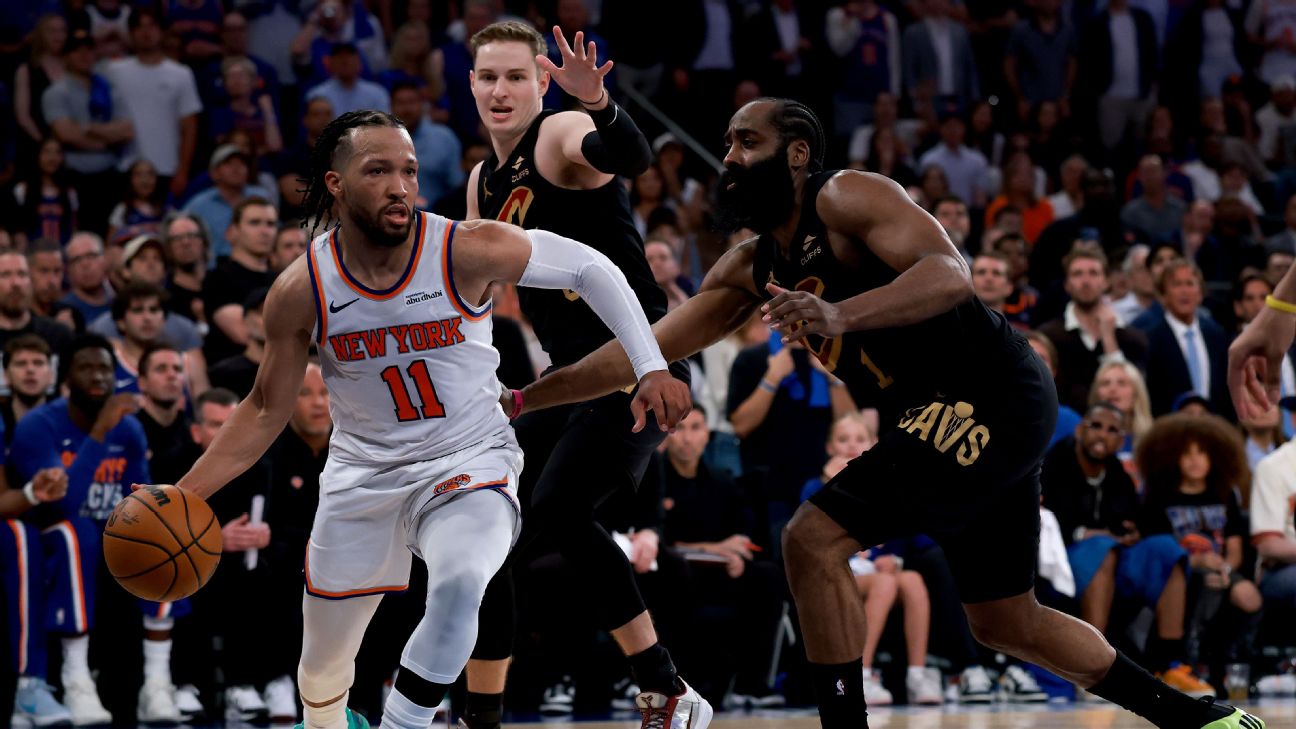
That was a blunt statement toward Cleveland guard James Harden. But it was no less vicious than the Knicks' treatment of the former MVP and future Hall of Famer throughout their historic comeback. They were relentless in seeking out Harden on the defensive end, and they took advantage of Cleveland's inability to stop Jalen Brunson from scoring on Harden.
This brutally successful tactic poses a thorny question for Cleveland as it enters Game 2 of the Eastern Conference finals (8 p.m. ET, ESPN). It also gives New York a blueprint to torch the Cavs' defense the rest of the series.

The tables have turned
The Knicks didn't start attacking Harden from the opening tip. In fact, they didn't target Harden with any picks in the first quarter, and they did so only six times through the first three quarters, according to GeniusIQ tracking.
But in the fourth quarter, facing a large deficit and a dwindling clock, the Knicks' offense used the man Harden was guarding -- typically Mikal Bridges or OG Anunoby -- to set a screen a whopping 16 times.
No guard had been screened more often in any playoff quarter in the tracking era (since 2013-14). New York targeted Harden with 27 picks overall, the most he had defended in a single game in his 17-year career.
Harden, incidentally, should be familiar with this single-minded approach. Out of 42 previous instances in the tracking era in which a guard had defended at least 10 screens in a quarter, more than half involved theGolden State Warriors'Stephen Curry. A large portion of those instances had Harden as the attacker back when he was a member of the Houston Rockets.
That approach made sense: Curry's teammates included ace defendersDraymond Green, Kevin Durant and Andre Iguodala. Prime Harden's best chance to score was to target their smallest defender, Curry.
New York has adopted the philosophy nearly a decade later.
Beginning with 8:30 remaining in regulation on Tuesday, the Knicks manipulated the matchups to switch Harden onto Brunson for 10 consecutive possessions. It stalled the first two times: Brunson passed to Karl-Anthony Towns, who missed a driving layup, and Brunson kicked out to Bridges, who bricked an open 3-pointer.
New York scored 18 points on the next eight possessions, 13 from Brunson alone. He beat Harden with floaters, pull-up jumpers and a crossover, behind-the-back dribble into a momentous 3-point splash. Fool me once, shame on you; fool me eight times in a row, shame on the Cavaliers' defensive principles for allowing such a streak.
While the Knicks forced Harden to defend screens at an unprecedented rate, they didn't force him to actually defend Brunson every possession. Yet Cleveland was perfectly willing to cede the switch, even as Harden repeatedly got beaten.
For instance, during the final play from that 10-possession run, Bridges' screen didn't even make contact with Cavs forward Dean Wade before the two Cleveland defenders switch.
At that point, the Cavaliers' 22-point lead had fallen to five points, and coach Kenny Atkinson called a timeout to change tactics. From then on, Cleveland mostly doubled Brunson -- but while that stopped his individual scoring, it opened lanes for Bridges and Anunoby, which helped New York tie the score.
Finally, with the Knicks down by two points in the last 30 seconds after a clutch Harden bucket at the other end, New York went back to what had worked all quarter.
Cleveland once more switched even before Bridges' screen made contact, and Brunson scooted around Harden for an easy score-tying floater. New York coasted in overtime from there.
Cleveland's defensive options
Harden isn't typically a disastrous screen defender. In the regular season, opponents scored 1.00 points per pick against Harden that led directly to a shot, foul, turnover or shot one pass away, per GeniusIQ. The overall league average was 0.99.
But in Game 1 against New York, that number was 1.53. When Harden switched, it was 1.80. (For reference, that's also the expected points per possession whenOklahoma City ThunderguardShai Gilgeous-Alexander draws a shooting foul.) Harden simply isn't equipped to match up against Brunson one-on-one in space.
The alternatives aren't very appealing. The Cavs can't hide Harden on the least threatening offensive player, because Donovan Mitchell also needs someone to guard. Doubling didn't work down the stretch in Game 1. Nor do the Cavaliers want to send extra help and get in rotation against the Knicks' offense, which would generate open 3s.
The best option might be for Harden and Wade to more actively fight through screens, rather than concede the switch so passively.
They can force Bridges and Anunoby -- who don't typically screen with the frequency of Knicks big men Towns and Mitchell Robinson -- to actually set firm picks or else stick with their initial assignments and make the 6-foot-2 Brunson score over the more agile (and 6-foot-9) Wade.
Generally, guards are more likely to switch than bigger defenders. Leaguewide this season, guards switched 45% of the time when defending screens, as compared with 30% for forwards and 13% for centers. That's in part because guards are typically better suited to defend the ball handler. But in Game 1, in this specific matchup, Brunson exposed Harden as poorly suited to that task.
Whether the Cavaliers can figure out and execute a better plan in Game 2 could dictate whether they steal a win in New York or return home down 0-2 for the second series in a row.
]
Related Topics
- SPORTS
- ESPN
- KNICKS OFFENSE
- CAVALIERS VERSUS-KNICKS
- EASTERN CONFERENCE-FINALS
- WADE DEAN
- SHAMET LANDRY
- MITCHELL DONOVAN
- MOBLEY EVAN
- PICKS
- BRUNSON JALEN
- CLARKSON JORDAN
- NBA
- HART JOSH
- 2026 NBA-PLAYOFFS
- ALLEN JARRETT
- CLEVELAND CAVALIERS
- ROBINSON MITCHELL
- NEW YORK-KNICKS
- MERRILL SAM
- ANUNOBY OG
- TOWNS KARL-ANTHONY
- BRIDGES MIKAL
- HARDEN JAMES