How important is pass protection for a running back? Ask Jaxson Dart

IT WAS SUPPOSED to be a routine dropback.
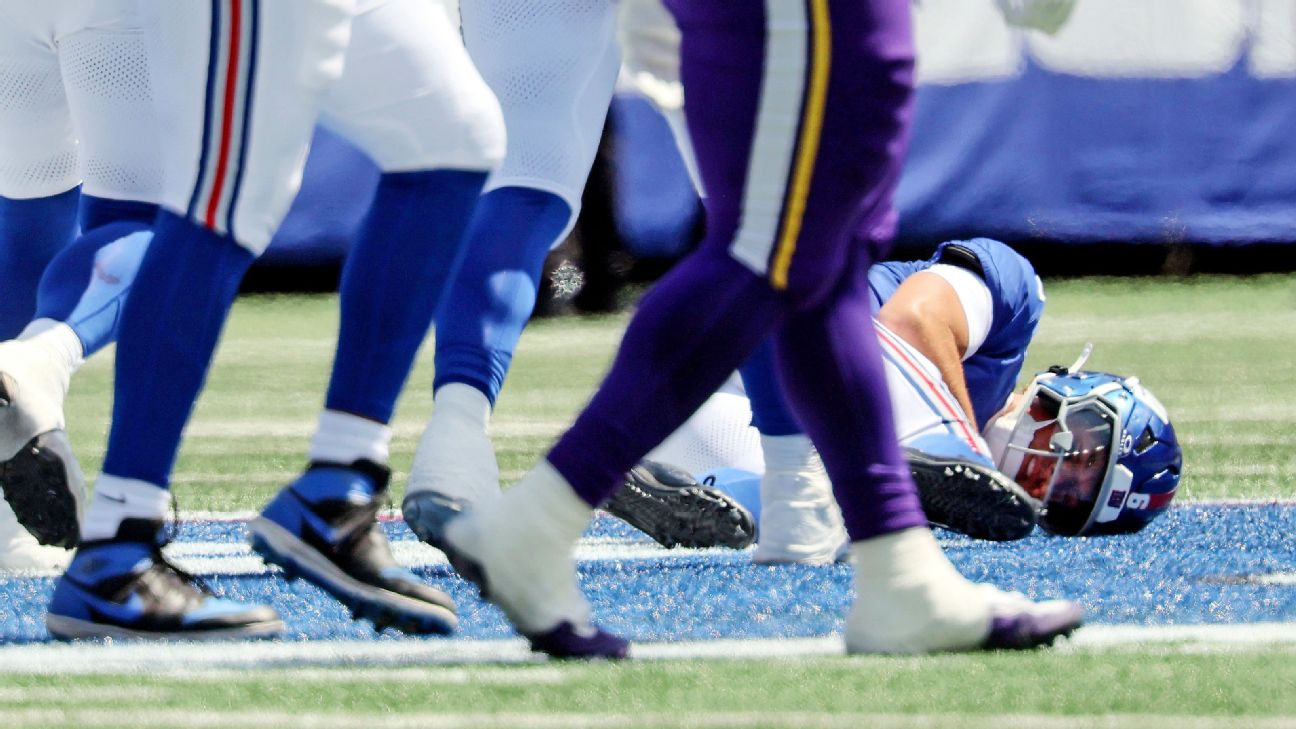
In theNew York Giants' preseason opener against the Minnesota Vikings on Saturday, starting quarterback Jaxson Dart dropped back and was looking left at his downfield options. On his right, chaos was looming.
Running back Tyrone Tracy Jr. drifted a bit too far right, tried to reverse course and slipped. Vikings safety Jay Ward sprinted toward Dart and leveled the quarterback. All Tracy could do was crane his neck backward while kneeling on the turf as Dart was crushed at the midfield logo.
Dart went through the concussion sideline exam and later returned. That didn't stop Giants coach John Harbaugh from saying, "There's no way he should have been hit there. It just shouldn't have happened. It was a basic protection."
The preseason play highlighted one of the most overlooked aspects of football: a running back's role in pass protection. Typically, the glory and grandeur for ball carriers depends on the number of yards and touchdowns they produce. But a running back who can block is invaluable, especially in the modern game. It's a skill that can secure a spot on the 53-player roster, earn offensive reps and even extend contracts.
And at its core, it sums up the nature of football.
"It's mano a mano," said Bengals running back Samaje Perine, who is one of the better backs at pass protection in the league. "Everybody else is covered up by linemen. It's just me and you, and may the best man win."
IN 2014, PERINE set the NCAA single-game record with 427 rushing yards in Oklahoma's win over Kansas. While he hasn't been as prolific in his 10-year NFL career, he still has been effective, averaging 4.5 yards per carry or more in five of his past six seasons.
But the primary reason he has earned nearly $14 million in his career is what he does when he isn't carrying the ball.
"As a running back, you can't be one-dimensional," Perine said. "If you can only run the ball and if you're not that [No. 1] guy, then your chances of staying in the league go down a lot.
"So I've learned that just the more you can do, the longer you can stay in."
What Perine and other effective pass-blocking running backs excel at is typically referred to as a "jet" protection -- where the offensive line will slide to block any defenders and the running back picks up an extra blitzer.
But here's what that actually looks like: a defender who weighs 200 pounds or more sprinting toward a player who is stationary and bracing for impact.
After his rookie year in 2017, Aaron Jones was at a charity event during Super Bowl week and ran into Brian Westbrook, an All-Pro running back who played for the Philadelphia Eagles from 2002 to 2009. Jones had one question: How do you get better in pass protection?
"He was like, 'That's your mom in the pocket,'" Jones recalled. "'Are you going to let him touch your mom? Are you going to let him hit your mom?'
"I was like, 'When you think about it like that, you're right.'"
Jones wasn't the only running back to gain counsel from a veteran during an early stage in his career. Before New England Patriots running back Rhamondre Stevenson went to the Senior Bowl in 2021, ex-Dallas Cowboy DeMarco Murray, then Stevenson's position coach at Oklahoma, told him that being a proficient pass blocker would generate more interest from teams.
Murray was right. Stevenson was drafted in the fourth round and is set to enter his sixth season with the Patriots.
And when Stevenson and other running backs execute a pass block to perfection, it can lead to big things from their offense.
"The underrated part about pass blocking is picking up a pass block and watching [Patriots quarterback Drake Maye] sit back there with time and throw a [deep ball]," Stevenson said.
Zach Allen, the Denver Broncos' 6-5, 285-pound defensive end who had seven sacks last season, has noticed something different about the 6-foot, 227-pound Stevenson.
"We played the Patriots, we did a stunt and I wrapped, and Stevenson was right there," Allen said. "Usually, you just bull the running back, but I gave him that first contact and I was like, 'OK, I might have to work to a side against him.' Powerful guy.
"A big body and he takes pride in it. It's easy to see when a guy doesn't."
WHEN THE 2024 season opener was on the line, Baltimore Ravens running back Justice Hill had one of the most daunting tasks in football: blocking Kansas City Chiefs defensive lineman Chris Jones, one of the game's fiercest pass rushers.
Hill, despite being 8 inches shorter and 115 pounds lighter than Jones, had to keep Jones off Lamar Jackson on back-to-back plays to give the Ravens a chance to win. And Hill did his job. Jackson nearly threw the game-tying pass at the end of regulation in a 27-20 loss.
The clip went viral as Hill received praise for one of the game's unsung jobs.
"Obviously I'm not the biggest guy, but it just takes a mindset of like, 'You're not going to get to my quarterback, and I don't care how big you are, how small you are,'" Hill said.
What makes pass blocking as a running back unique is that it is one of the more teachable skills in football. The calculation is pretty simple.
"It's probably 90% grit, 10% technique," Perine said. "Because at the end of the day, you just have to get in the way."
That is always easier said than done, especially when facing someone likeDerwin James Jr., the Los Angeles Chargers' 6-2, 215-pound safety.
"Most everybody else, they'll run at you, but then they'll break down at least a little bit to give you a chance to think what you're going to do," Perine said. "Him? He doesn't care. He's just going to run full speed straight into you, torpedo style."
But a lot goes into that 10% of technique. At the beginning of each game week, Bengals assistant coach Justin Hill will spend considerable time identifying defensive fronts, patterns and what makes different players effective as a pass rusher. Any edge gleaned that can give the quarterback an extra split second is valuable.
"It's not just about being physical at the point of attack," Justin Hill said. "It's also about you got to be smart enough to understand what the different looks are."
And sometimes, looks can be deceiving. The Giants thought it wasJamal Adamswho was going to be blitzing on the play that dropped Dart.
"I didn't really think I would have a free rush, but our big nickel -- Jamal -- he sold it, so the protection slid to him," Ward said. "The back so happened to get ready to go into a route and ... he didn't think he had anyone [to block] and he seen me come late, and he couldn't adjust."
Aaron Jones said pass blocking is a two-part process, with the first part being able to understand the protection scheme.
"And then it comes to a want-to and a fight," he said. "So, I would say part of it is understanding protection, and the next part is having the willingness to do it.
"Now we know every protection is not going to be perfect, but if you get in there and fight and you hit them first, that negates a lot of their charge. Now you're just hand fighting and standing in front instead of this guy hitting you. A lot of times when you get up there and you make that contact, it slows it down and it makes your job a lot easier."
BEING A RELIABLE pass blocker and adding value to teams will be paramount across the NFL over the next couple of weeks. As teams prepare to trim their rosters from the 90-player limit in training camp down to the allotted 53 roster slots for the regular season, protecting the quarterback could prevent a running back from being cut.
"It's crazy how long that can extend your career," Justice Hill said. "If you told me my second year when I felt like s---, 'You'll be playing here,' standing here at eight years, I wouldn't have believed it.
"So yeah, just keep doing those little things, and it pays off long term."
Hill didn't mean to minimize it, but "little things" probably wouldn't fit Harbaugh's definition of pass protection.
"If you're going to be on the field on third down or second-and-long, so-called pass downs, you have to be a great pass protection guy because you're going to be throwing the ball a lot," he said. "So, that'll be a requirement."
TheTennessee Titans' Tyjae Spearsisn't the biggest back at 5-11, 195, but he knows how to stay valuable.
"If it's on my watch, you ain't gonna hit the quarterback," he said. "I'm going to do what I can to protect him."
When Jones entered the league in 2017 with the Green Bay Packers, he immediately knew what it would take to stick in the NFL. Inside the team's running backs room was a sign that said it all: "If you can't protect, you can't play here."
"That goes to say, 'Hey, this is a $100 million man back here at quarterback,'" Jones said. "'If you can't protect, we can't trust you to be in that league. You're going to get him hurt and that's our investment.'"
And along with their ability to pick up yards when needed, that's why Jones, Perine and so many backs have remained gainfully employed. When the rosters are trimmed, many others will follow suit because they have learned one of the biggest truths in football.
"As long as you're in front of your guy when the quarterback gets the ball off," Perine said, "then that's all that matters."
Turron Davenport, Jamison Hensley, Mike Kaye, Jeff Legwold, Jordan Raanan, Mike Reiss and Kevin Seifert contributed to this report.br/]