Man paralyzed from chest down undergoes first-of-its-kind procedure on LI
MASSAPEQUA, Long Island -- Three years ago, Keith Thomas of Massapequa described the moment a dive into a shallow pool in 2020 changed his life.
"Hit my head at the bottom of the pool, broke my neck," he said.
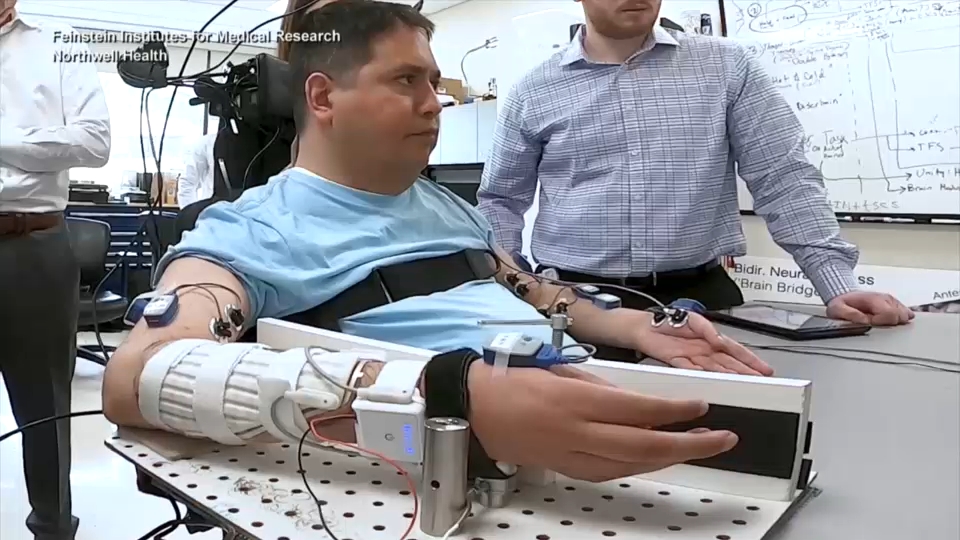
Thomas was left paralyzed from the chest down, but in 2023, he became the first patient in the world to undergo a first-of-its-kind 'Double Neutral Bypass' procedure at the Feinstein Institutes for Medical Research on Long Island.
Doctors implanted five microchips in his brain, using artificial intelligence to reconnect signals between his brain and body. At the time, Thomas was just beginning to regain movement and was able to lift his arm just a few inches. Now researchers say they are seeing results that go far beyond those early milestones.
"There are signals from his motor area responsible for movement going to the computer and signals from the computer are going back to different stimulation points in his body, brain and spinal cord. And the goal is to restore movement and a sense of touch in a lasting way," said Dr. Chad Bouton.
Then, Thomas hoped for simple things that many people take for granted. Now, he can feed himself, drink from a cup, scratch his face and lift his arms to his mouth - tasks that were impossible after his injury. Researchers say he is also beginning to regain natural sensation.
"He's already starting to feel sensations in certain parts of his arm and even wrist. We have started to see some lasting new sensations in his arm that are present even when we turn off the bypass," said Dr. Bouton.
For Thomas, one of the biggest breakthroughs is not about technology at all, but is about feeling human connection again.
"It's unreal, 'cause I haven't felt that in years," Thomas said.
What started as an experimental procedure is now providing new hope. The team at the Feinstein Institutes is now planning wider trials with hope the technology can one day help stroke patients as well.