Inside Sleepy Hollow's 300-year-old Old Dutch Church

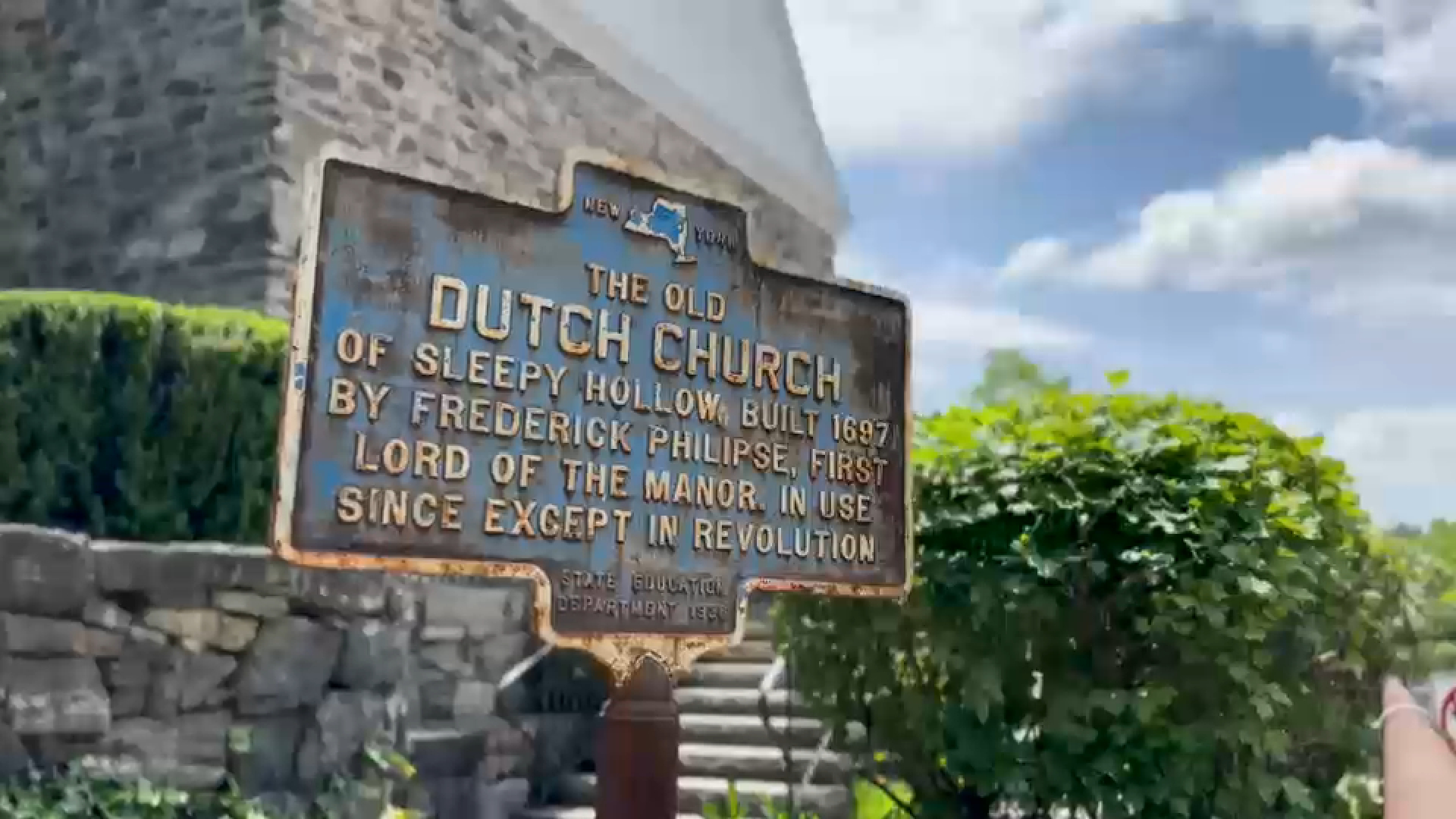
SLEEPY HOLLOW, New York (WABC) -- The Old Dutch Church of Sleepy Hollow is one of the most legendary places in America. Across the span of more than three centuries, the oldest standing church in New York State has witnessed the rise of colonial New York, the American Revolution and the entire history of the United States.
Perhaps most famously, the picturesque stone church's identity is forever linked to the story of "The Legend of Sleepy Hollow" and its frightening protagonist, the Headless Horseman, unleashed on this rolling Hudson Valley countryside by the imagination of author Washington Irving.
Founded in the late 1600s by merchant Frederick Philipse and his wife, Margaret Hardenbroeck Philipse, the church was built to draw Dutch settlers to the family's sprawling 55,000-acre estate, which had once been the homeland of the Lenape people.
"The church here was built as a way to attract (settlers)," said Deborah McCue, the church's docent. "We have a bell in our belfry that was brought over from Holland by Margaret Hardenbroeck. We date the beginning of our church from that bell," or 1685.
During the Revolutionary War, the church in what is now appropriately called Sleepy Hollow, New York, sat in what was known as the "Neutral Ground" - a dangerous stretch of land between British and American lines. Farmers living nearby found themselves caught in the middle, with both armies seeking their livestock and crops.
That wartime history would later help inspire one of America's most famous ghost stories.
While Washington Irving didn't invent the idea of a headless horseman, historians say he drew from European folklore and local Revolutionary War history to create the legendary Hessian soldier who haunts Sleepy Hollow - and terrorizes the hapless, lovelorn schoolmaster Ichabod Crane.
"Having a Hessian soldier show up at your door was a frightening thing," said McCue. "They were usually there to loot and burn."
A newspaper account published in 1798 described an American cannonball decapitating a Hessian soldier during the Revolution, years before Irving published "The Legend of Sleepy Hollow" in his 1819-20 collection, "The Sketch Book of Geoffrey Crayon, Gent."
Historians believe that existing lore, combined with Irving's literary mastery, helped shape the tale that would forever define the region.
"It sits at the crossroads of so many layers of American culture - from the Lenape community and the Dutch period to the British colonial era. In some ways, Washington Irving ushers in an American age," McCue said.
The church survived the war, but nearly disappeared in 1837 when a fire damaged much of the building. Parishioners saved the structure and carefully rebuilt it, preserving much of what visitors see today.
Now, more than 325 years after its congregation was established, the church, which sits next to the separate Sleepy Hollow Cemetery, remains an active place of worship while welcoming visitors eager to explore the intersection of history and folklore.
It is one of those special places where the line between the secular and sacred is thin, said John Paine, the church's sexton.
"I feel very deeply that this is one of those places," he said.
Today, the Old Dutch Church - surrounded by the historic gravestones of the Old Dutch Burying Ground with their haunting soul effigies - continues to connect visitors with the people, events, and stories that shaped both the Hudson Valley and the American imagination.
"This is a touchpoint in all the things that make America a great place, and all the things that make New York a great place and all the things that make the Hudson River a great place," Paine said.
The church, a popular place to visit all year but especially in October during Halloween season, could use the public's help. They are raising funds to build a new roof for the gambrel-style stone building. Here is how you can help.
----------
* Download the abc7NY app for breaking news alerts
* Download our connected TV app
Submit a tip or story idea to Eyewitness News
Have a breaking news tip or an idea for a story we should cover? Send it to Eyewitness News using the form below. If attaching a video or photo, terms of use apply.