Why more NFL teams than ever are using GoPros on their QBs

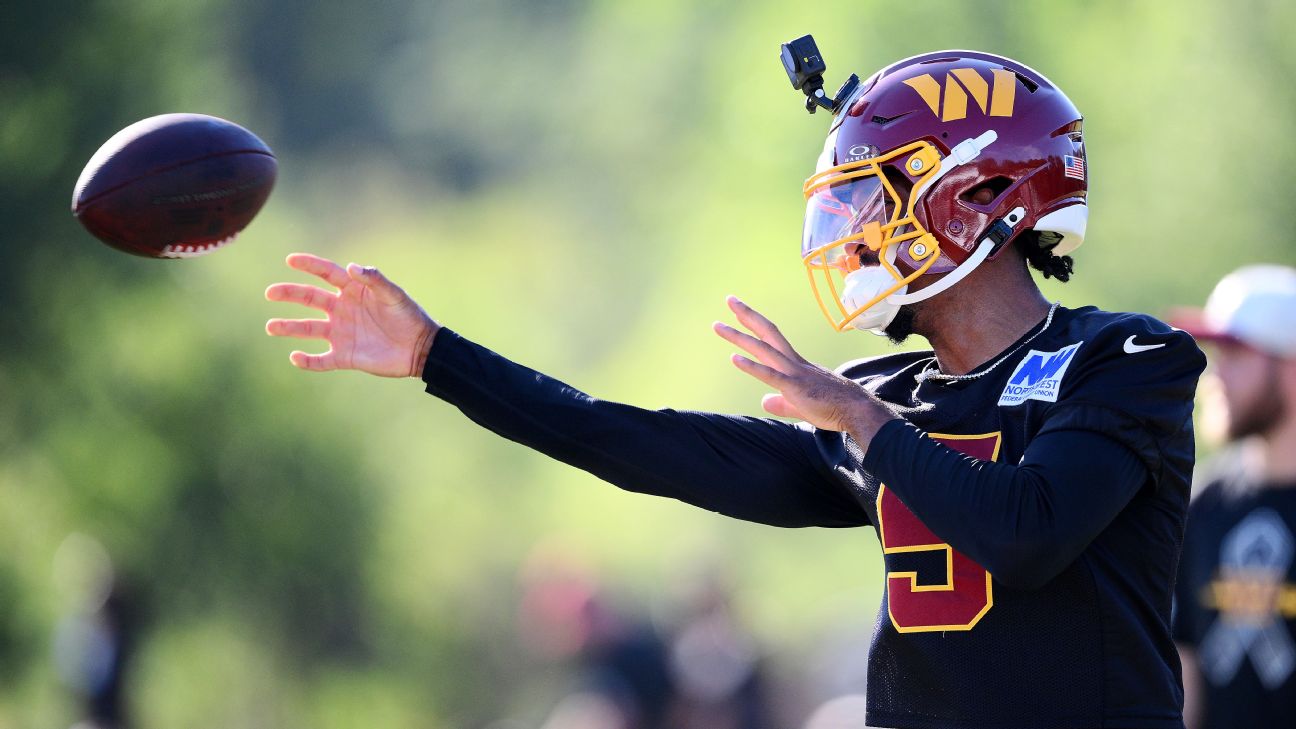
ASHBURN, Va. -- Washington Commanders quarterbacks coach D.J. Williams heard something that resonated with him after listening to quarterback Jayden Daniels call a play in the huddle.
It wasn't the third-year quarterback giving additional instructions to his offensive line, running backs or receivers. It wasn't words of encouragement to the unit, either.
It was ... singing.
As Daniels surveyed the defense at the line of scrimmage, he was crooning along to the song "Here We Go Now" blasting over the practice facility's loudspeaker.
Then, he called out the cadence, took the snap and delivered a strike to third-year receiver Luke McCaffrey for a touchdown. Williams saw the completion live, but he heard the rest later while rewatching practice thanks to what was attached to Daniels' helmet: a GoPro camera.
"He was bobbing his head, singing the song and then he said 'hut' and made the play," Williams said.
The Commanders are one of six teams -- along with theMiami Dolphins, Cleveland Browns, Dallas Cowboys, Philadelphia Eagles and New England Patriots-- that have equipped the tiny, mountable devices on their quarterbacks' helmets this summer. The reasons vary: In some cases, it's for the vision the camera provides, which helps coaches and players see each play from the quarterback's vantage point. In others, the value is in giving coaches a peek into the communication taking place on the field, helping them get deeper insight into how QBs and other players -- such as the center making protection calls -- are communicating at the line and in the huddle. The cameras have even been experimented with on defense.
Washington, particularly, has found the camera useful to gauge Daniels' comfort level and progress in new offensive coordinator David Blough's system, but others haven't seen the need for the technology. The Kansas City Chiefs, for example, have never used a GoPro on their quarterbacks. Instead, coach Andy Reid stands roughly 10 yards behind the offense during 7-on-7 and full-team sessions.
"I'm a versatile GoPro," Reid said, laughing.
For those teams that do use them, the GoPro can provide help, particularly if there's a young quarterback or a new offense -- such as in Cleveland, where the Browns have a new scheme and three quarterbacks who are either rookies or in their second season.
"It's a valuable tool," said first-year Browns coach Todd Monken.
THIS ISN'T THE first time football teams have used the technology. GoPros have been used in college for a while. Former NFL quarterback Nathan Peterman said he used one while he played at Pitt in 2015 and 2016. The Arena League used an in-helmet camera in 2014 that was designed to give viewers, not so much the coaches and quarterback, a different perspective. The Miami Dolphins and Pittsburgh Steelers experimented with helmet cameras in 2023, and the Eagles had used one as far back as 2016.
This summer and offseason, NFL teams have adopted the cameras more than ever. Perhaps the most obvious reason is the view a camera provides for evaluation purposes.
Browns starting quarterback Deshaun Watson said he likes the vision it highlights. He can be taken back into the huddle to see how the offensive players are responding to him through their body language and eye contact. Then, he can review his post-snap progression -- where he's looking on each pass play.
"It's a good point of view, a different point of view for us to learn and study," Watson said.
Miami quarterback Malik Willis, who signed with the Dolphins as a free agent following two seasons in Green Bay, is using a GoPro for the first time this year. He, like Watson, said he uses it to check his eye progression and likes being able to see the different landmarks on the field where they want plays to attack.
Willis said the ability to review reps from his own perspective provides him with lessons and information he wouldn't have received otherwise.
"Spatial awareness and understanding some of the coverage recognition stuff," Willis said. "It gives you the same view you had when you were on the field and then you can see what coverage it went to and it's like -- you can take that with you, because you will be in that same position again. It's different from looking at it from the sky view, but it's awesome. I love it."
The other reason NFL teams have gone to GoPros this summer is perhaps more surprising: the audio.
"... Unless you want to be standing in the huddle to hear what's actually being relayed from myself, to them, to the players," Monken said. "And then it allows you to pre-snap and then, post-snap, get an idea where their eyes are. Are they in the right place?"
The sound capture allows coaches to hear how a quarterback manages the huddle and the line of scrimmage.
"So much is done pre-snap, and that's what the GoPro gives you," said Browns quarterbacks coach Mike Bajakian. "It gives you the quarterback's thought process and his communication."
That's why Minnesota mounted one on veteran QB Sam Darnold in 2024. The Vikings wanted to help then-rookie quarterback J.J. McCarthy catch up on the offense while he was sidelined with a torn ACL. They wanted him to see Darnold's vision and how he spoke in the huddle -- how clear and concise McCarthy would need to be when relaying information, calling out each play with conviction.
They presented him the information by rewatching practices from the GoPro's perspective on a large wall in their draft room.
"It's pretty cool," offensive coordinator Wes Phillips said at the time.
GOPROS ARE NOT for everyone, however. Reid has been a head coach three years longer than the GoPro, created in 2002, has existed. Some other teams and coaches find similar benefits using different means.
Chicago Bears offensive coordinator Press Taylor said he remembers seeing quarterback Chase Daniel use one in 2016, when Taylor was an assistant quarterbacks coach with the Philadelphia Eagles. But it's not something the Bears use now. Instead, he said they get the same information by using pole cameras, which he estimates are around 8 or 9 feet tall and positioned about 7 yards behind the quarterback. They're also miked up.
"It's probably very similar," Taylor said.
The New York Jets used a GoPro last year, but new offensive coordinator Frank Reich and quarterbacks coach Bill Musgrave opted against the technology this season. Instead, the Jets are using a camera for a down-the-line view, aiding the defensive line so they can tell if they're aligned onside. Coach Aaron Glenn said players would often ask if they lined up offside. Now they can tell.
"The film doesn't lie, so we get a chance to watch it that way," Glenn said. "Every coach is different, and I want those guys to be able to coach the way they feel like they can get those guys to improve, so that'd be the reason why [they stopped using GoPro]."
There are other ways quarterbacks try to enhance their game. Washington's Daniels has used a virtual reality headset since his final year at LSU, when he won the Heisman Trophy. He prefers those visuals over the GoPro.
"I don't go back and watch it," Daniels said of the GoPro footage, before adding that he does value the audio component, "because it's on top of the helmet and my eyes might be somewhere else, but my helmet's that way."
Commanders backup quarterback Marcus Mariota is entering his 12th NFL season. He said he has been open to using a GoPro for the first time. He cited his background playing at the University of Oregon, where they were "always pushing the envelope."
Mariota agrees on the audio benefits, but, like Daniels, also sees limitations with the visual element. He said it shows a wider range of vision than he sees on the field. Sometimes he'll be asked if he saw how a linebacker or corner was situated because the GoPro picked it up.
"You're like, not really because I'm kind of facing a different way," Mariota said. "So you're not getting the full picture necessarily."
It might have even helped on the other side of the ball. Washington used it on some defenders in the spring, including linebacker Frankie Luvu and safety Jeremy Reaves. Both had it removed.
It did help Reaves see where his eyes were on a play, or to gauge his progressions. But the experiment didn't last long: The GoPro is attached via a super sticky mount, and because quarterbacks can't be hit, the device is not in danger of falling off. On defense, it's another story.
"It's so hard on defense, where you're liable to hit someone and break the GoPro. That's why we couldn't do it," Reaves said.
BLOUGH BECAME INTRIGUED with the GoPro after watching some of offensive assistant coach Wes Welker's film from his time coaching in Miami. Blough heard the audio of quarterback Tua Tagovailoa informing players what to do in various situations.
With Daniels in a new offense, and calling plays in the huddle more than his previous two seasons under former offensive coordinator Kliff Kingsbury, Blough wanted to listen to his progress in these areas. It helps them hear how Daniels handles various situations in the huddle: on a late drive telling teammates they're going to clock the ball or take a knee or call a timeout after the ensuing play, or reminding receivers to get out of bounds after a catch. It's what Blough heard Tagovailoa telling his Dolphins teammates.
They also have heard the evolution of Daniels' leadership.
"When people ask me where he's grown as a leader," Blough said, "I'm able to reference things that I've heard of him walking in the huddle and saying, 'Hey, let's break the f---ing huddle! You guys get set. This is how we're going.' And that's a different thing than he's ever had to do."
Indeed, Washington will huddle far more than in the past. The Commanders led the NFL with 1,279 no-huddle plays the last two seasons, 815 more than any other team. Blough said shortly after being hired that if they do it 20% of the time this season, that would be a good number.
Hearing how Daniels sounds in the huddle matters.
"[It's] that next step of 'Hey, just make sure you [are] 2 yards outside the hash on this one' or 'Hey, just remember this,'" Williams, the Commanders QBs coach, said. "Things like that I think are the next level that make the greats great. It's when you can help guys within the play, just little tidbits and reminders on certain things, like the details."
But it took time. Blough said Daniels has improved at calling plays, especially as he grew more comfortable with the new terminology. "If you don't call a play with conviction, it's like, are you asking me or telling me?" Blough said. "So he can walk in the huddle and say, 'Hey, Brown left F right sprint right GX corner H flat.' And he can point to people and you can see all of that. You can see people's reactions. You can [hear] the questions that people ask. And so it's very valuable in that aspect."
Then there are the other fun things that can be heard, like Daniels' trash talk. In one practice, he ran a bootleg and linebacker K'Lavon Chaisson bit on the fake, giving Daniels the edge.
As Daniels scooted around Chaisson, he yelled "Got your ass!" and threw the ball for a completion. Another time, rookie linebacker Joshua Josephs was, as Blough said, "chirping at him." Daniels playfully yelled "Shut your ass up, rookie."
Then there was the singing completion. Blough loved what he heard on the play. Not the quality of Daniels' singing voice, but the glimpse into an even deeper level of his evolution in the offense.
"He was relaxed," Blough said. "It told me that he was in the zone."
ESPN NFL Nation reporters Marcel Louis-Jacques, Kevin Seifert, Courtney Cronin, Nate Taylor, Daniel Oyefusi and Rich Cimini contributed to this report.br/]