NBA playoffs 2026: Can Point KAT take New York to the Finals?

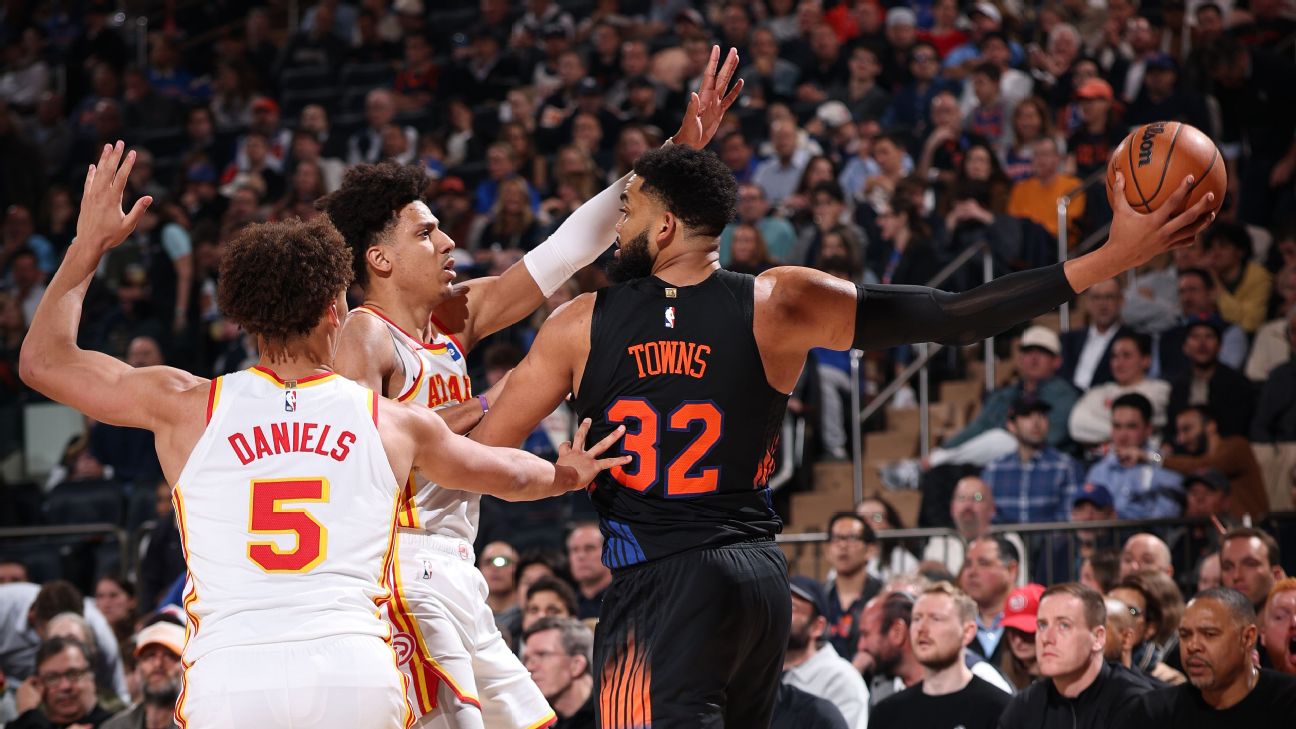
IT WASN'T QUITEa crisis point, but perhaps it was a crossroads. The New York Knickswere trailing 2-1 in the first-round series against the pesky upstart Atlanta Hawks.
The Hawks had proved they were uniquely qualified to handle the Knicks' offense with Jalen Brunson as its fulcrum, employing switchable defenders who had no problem selling out against New York's undersized captain and top scorer. After all, the Hawks hadn't needed to worry about much else through the series' first three games.
But Knicks coach Mike Brown, who had spent virtually all of his first season at the helm in New York wrestling with how to best use Brunson's most decorated teammate,Karl-Anthony Towns, was about to deliver a message that would turn the squad into a playoff juggernaut.
In the team's film session on the day between Games 3 and 4 in Atlanta, things got real. Brown is soft-spoken when speaking publicly about his players, but film sessions are often autopsies in which unspoken truths are laid bare and accountability is demanded.
And during one moment on that late-April day in Atlanta, Brown looked to Towns.
The film had just shown a play from Game 3 in which Towns was supposed to screen for Brunson but stood in the corner instead. Brown called him out. "You want the ball? What are you doing here?" a source with knowledge of the film session told ESPN.
Whether it was a watershed moment or a last-ditch effort from Brown to revive a Knicks season nearing its brink, that film session birthed the machine that has become the team's playoff offense, which has powered seven consecutive wins heading into Tuesday's Game 1 of the Eastern Conference finals against the Cleveland Cavaliers (8 p.m. ET, ESPN).
It began with a demolition of the Hawks. The Knicks closed them out in Game 6 with a 59-point drubbing. "In a way, it felt like [Brown] saying, 'Screw it, I'm going to do things my way,'" one Knicks player told ESPN of the style change.
Going down 3-1 in the first round -- afterKnicks owner James Dolan shared his NBA Finals expectation in January-- would've been disastrous. Panic, especially in the cauldron of New York City and Madison Square Garden, surely would have set in. "The Atlanta Hawks made us better," Brown said after the series.
For Brown, necessity sparked innovation. He retooled the offense on the fly, adding facets of the now-legendary Golden State Warriors movement philosophy implemented by coach Steve Kerr. Brown saw plenty of it as a Warriors assistant from 2016 to 2022.
As a result, New York's most recent wins have been enormous, with a point differential of plus-24.5 during the franchise-record playoff winning streak. The team's offensive rating during the streak (130.5 points per 100 possessions) is the best among 2026 playoff teams, and it's shooting 60% from the field and nearly 40% from 3-point range -- all well above its season averages.
The shift didn't exactly come out of nowhere. "We've had it," Brunson said, as Brown used the sparse practice time during the regular season to put a secret weapon in place:
In case of emergency, unlock Point KAT.
AFTER GAME 4 in Atlanta, there was no indication the Knicks' offensive shift was much more than a one-game reprieve. Towns' triple-double that night was just his second of the season, and there wasn't much statistical evidence to support a move to a full-time point-center role.
Towns is one of the best shooting big men in NBA history, but he is also a skilled passer and wears No. 32 because Magic Johnson is his idol. In that Game 4 win, Towns found OG Anunoby for six of his 10 assists, and it was infectious. When Towns drew two defenders driving to the basket, he made easy passes for 3-point shots. When the 7-footer peered over smaller defenders from the top of the key, he could easily locate cutters coming off screens.
And during the Knicks' current run, his averages have looked like he has played point-center his entire career: 15.7 points, 9.6 rebounds and 8.0 assists on 60% shooting in just 26.3 minutes.
"He's been a big inspiration in my life, and to be able to have this moment is great," Towns said afterward, referencing Johnson, who is considered by many to be the greatest point guard of all time. "Like Magic, I always talk about impact and winning, and to be able to amplify my teammates is one of the greatest honors."
The Knicks looked more like Kerr's Warriors than the Showtime Lakers, but Towns' teammates seemed to get a jolt of energy from his performance. The style of play made everyone feel involved, and its unpredictability kept them alert. "When you have guys that pass the ball, like Draymond Green, like[Domantas] Sabonis, like KAT, you try to utilize their strengths to help others out, make others better," Brown said earlier this week.
"Putting KAT in that position, knowing that we have great screeners, great cutters and a great facilitator, was something that was definitely easy to say, 'Yes, let's try it.'"
This is Towns' third consecutive conference finals. In his first two trips -- last season with New York and in 2024 with the Minnesota Timberwolves, he tallied 66 assists in 34 games, or 1.9 per game. In just 10 games this postseason, he has already matched that total for a robust 6.6 per game. Towns' time of possession has also skyrocketed. Based on GeniusIQ tracking, six of his top eight games by on-ball percentage this season have come during this recent surge.
Green and Sabonis, whom Brown coached in Golden State and with the Sacramento Kings, respectively, were a bit different from Towns. Those big men used passing as a way to make up for their shooting deficiencies and keep from clogging the lane. Towns is a much more diverse shooter, so this playmaking revelation has made him much more difficult to guard.
The pivot has also subsequently unlocked other struggling Knicks. Anunoby was already having a great start to his postseason, scoring 29 in the losing effort in Game 3 vs. the Hawks. But this newfound system ensured he doesn't get lost. (Anunoby, who is dealing with a hamstring injury, is listed as probable for Tuesday's conference finals opener.)
And it might've saved Mikal Bridges from being persona non grata in New York. Bridges went scoreless in 20 minutes in Game 3, and Brown was asked about benching the player the Knicks traded much of their draft capital for, with the season on the line. Since then, Bridges has been refreshed, averaged 15.6 points on 67% shooting and 44% from 3-point range.


As for Brunson, his numbers haven't taken a hit: 27.4 points per game with less than one fewer assist. Meanwhile, he's having his most efficient postseason as a Knick.
That's in part because Towns isn't just passing more overall; he's passing with more purpose. This postseason, 18.5% of his passes have turned into assists, per GeniusIQ, which leads the league (minimum 100 passes). That rate is more than double what Towns managed in the regular season. He also joined Hall of Famer Walt Frazier as the only Knicks with multiple playoff triple-doubles -- at any point in their careers, not just within a single postseason.
It's a style shift that has undoubtedly paid off for the Knicks and their star center. But it also begs the question: Where was this all season?
BROWN WAS TASKED with many things throughout his first season at the helm in New York. Maximizing Towns seemed low on the list of objectives, a talking point that dominated much of the Knicks' regular season. Towns, for his part, toed the company line, only occasionally letting on any awareness that his production had dipped from his All-NBA first season in New York.
The difference in Towns' numbers before this season's All-Star break and his numbers from 2024-25 was stark. That, plus the lack of a contract extension on the eve of this season, could have created a rift between star and franchise.
Last season, Towns averaged 24.7 points and 13.3 rebounds on 53% shooting, including 44% from 3. In the new setup under Brown, Towns was down to 19.8 points and 11.9 rebounds on 47% shooting, including 37% from 3.
"I've unfortunately had to adjust to a lot of head coaches," Towns said in January. "A lot of new teammates and situations and stuff, so just leaning on my experience, and we've got to do what we've got to do to move forward."
And following a third straight thrashing at the hands of the Detroit Pistons in the first game after the All-Star break, this time at Madison Square Garden, Brown tried to lay out the pecking order to keep things clear. He held his hand up to signify Brunson as the first option. He brought it down a few inches to where Towns landed.
"I look at [Towns' offense], and he's probably right where it should be," Brown said before the Knicks' comeback win over the Houston Rockets in February. "He gets the second-most attempts behind Jalen. ...
"If this doesn't work, I got to change this. Our offense is different from now to what it was in the preseason, because I had to adjust."
From that point on, so did Towns. He didn't take more shots; in fact, his attempts decreased. But he has always been an effective offensive rebounder, so he put more emphasis on getting to the glass for his scoring opportunities.
Towns' efficiency soared for the rest of the season: 58% overall and nearly 42% from 3, huge jumps from his pre-All-Star production. The raw numbers didn't take a leap, but Brown admitted he made alterations to the offense to feature Towns more heavily.
But the first real glimpse of Point KAT didn't come until April 1. With Brunson sitting because of ankle soreness, Towns was seemingly unlocked during a 20-point, 11-assist, 11-rebound performance on the road against the Memphis Grizzlies.
Towns now has four games with double-digit assists since the start of April: the win in Memphis, Games 4 and 6 against Atlanta and the clinching game of the Knicks' sweep of the Philadelphia 76ers. But, with the franchise's first Finals appearance this century at stake, Towns and the Knicks' retooled offense will face their toughest test yet.
NEITHER THE KNICKS nor the Cavs are truly prepared for what they will see when the conference finals tip off Tuesday night at the Garden.
Last round, the 76ers were in some ways too perfect a matchup for the Knicks. Because Philadelphia wanted to protect Joel Embiid from being exposed with his recent injuries, they elected to have Embiid sag off when guarding Towns. It provided more than enough space for Towns to evaluate cutters and off-ball screens. And when smaller defenders such as Paul George took on the assignment, Towns saw over the top.
When he drove to the basket, defenses collapsed, leaving players such as Brunson, Anunoby and Bridges for open looks. (That's especially true on corner 3s, where the Knicks shattered the NBA record with more than five per game in the regular season.)
Easy work.
That won't be the case against Cavs big men Jarrett Allen and Evan Mobley (last season's Defensive Player of the Year), who could be uniquely qualified to defend Towns' actions and cover space in the paint.
The Cavaliers, however, haven't had to deal with any big man as versatile as Towns. Against the Detroit Pistons last round, Cleveland was able to shut down Cade Cunningham's pick-and-roll game with center Jalen Duren, who in turn wasn't much of a facilitator. The first round provided Cleveland's bigs even less of a challenge, as Toronto Raptors center Jakob Poeltl totaled just 10 assists in the seven-game series.
Towns made some interior passes in the series against the 76ers, even finding fellow center Mitchell Robinson on the few occasions the two shared the floor. If Towns gets around one Cavaliers big, another will likely be waiting in the paint, cutting off clear passing lanes. But Towns also has the advantage of being bigger, should he want to exploit his size and turn into more of a scorer, even if it bucks the trend of how he performed against the Cavaliers this season.
In three regular-season matchups against Cleveland, Towns averaged just 14.7 points (his third fewest against any opponent) and 2.0 assists (tied for his third fewest). His 22% usage rate was well below his 26% overall usage.
Mobley and Allen mostly split the Towns assignment, while Dean Wade -- one of Cleveland's primary defenders on Brunson -- also defended the Knicks center after switches.
The time off has allowed the Knicks to fine-tune this offense even more, but like other rounds, the Knicks will be adaptable and could go back to the offense they've used for most of the season, when they were a top-five unit.
Either way, Point KAT has proven he can be New York's fail-safe option in these playoffs.
ESPN's Zach Kram contributed to this story.br/]