Overheard at the NHL scouting combine: Draft, prospects, trade buzz

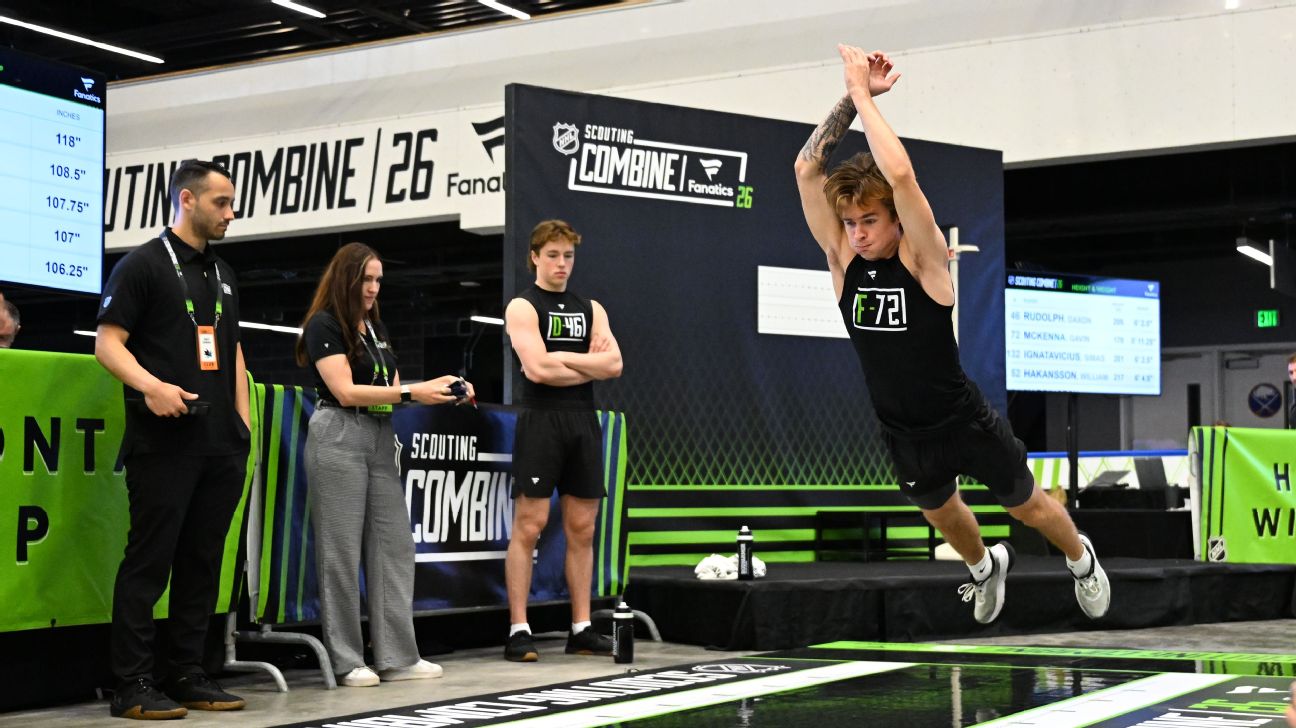
BUFFALO, N.Y. -- The NHL scouting combine is an event that prospects both love and hate for different reasons.
It's the precursor to what will (hopefully) be one of the biggest accomplishments of their young lives -- being selected in the NHL draft, which will be held June 26 and 27.
The combine is where teams get to really know the league's next wave of skaters. There are fun things to do -- fancy restaurants, interesting conversations, plenty of off-ice time with their peers -- and some things that are not so fun (no one enjoys the Wingate testing, let's just be honest).
There is no shortage of information to gather about physical fitness and various off-ice personal preferences. Some things were all but confirmed this week -- like Penn State's Gavin McKenna maintaining his inside track as this year's top pick -- and there was the opportunity for other draftees to move up a few slots on the board.
And of course, there was no shortage of agents, scouts and team executives mingling among their colleagues to discuss the latest goings-on in the hockey world, exchange notes on prospects and generally catch up on what's ahead in the next few weeks between the draft and the start of free agency on July 1.
Here's a roundup of the best nuggets from the combine to dissect before future NHLers return to Buffalo to find out where they'll (potentially) be spending their first professional years.
Inside the interview rooms
Scouts and executives know what a player can do on the ice well before they pull up to the weeklong prospect showcase.
That's when it's on the players to give the teams information they can't get from footage.
For example: Are you a pickleball aficionado? Or an avid golfer?
Or how about what's your plan when stranded in the Sahara desert, a full day's walk from water, but with another person who had a bottle of water? Would you kill that person for their refreshment? The Montreal Canadiens wanted to know (and yes, we do wonder as well who comes up with these queries).
Tobias Trejbal, a goalie for the USHL's Youngstown Phantoms, had a highlight-reel-worthy response to an extended version of the question:
"They asked, 'If you were in the Sahara and there were two guys, one had a bottle of water and the other had a baseball bat, what would you do?'" he said. "And their [one] guy told me, 'I have a wife at home. I have kids at home; like, are you gonna really kill me?' I said, 'Yeah, your family is at home. They're safe, and I have my whole life in front of me, and I want to play in the NHL, so I will smack you with the baseball bat.'"
The Canadiens also asked their invites to throw a puck from the back of the room into the trash -- telling them that if they didn't make the shot, they'd never play for Montreal. That's one way to test a player's ability to perform under pressure.
Pittsburgh Penguins GM Kyle Dubas was up to his old tricks, showing video clips to each player and asking them to go through why they made a play. Prospects spoke about being shown a negative clip and walking the Penguins through their thought process and decision making.
It's a good way to determine how well a player thinks the game, processes information and can be accountable and self-critical of their play.
Moncton Wildcats defenseman Tommy Bleyl took his draft standing in his hands when he told the New York Islanders that he grew up a New York Rangers fan (yikes!) but admitted New York as a whole has the best pizza in the world. That'll get him a brownie point back.
The Islanders had a crust of their own for prospects to chew on: They put a brick in front of guys and asked them to detail (in just 30 seconds) how many things they could do with it. North Dakota's Keaton Verhoeff said he managed to come up with eight.
What teams, prospects get out of dinners
It's arguably the most important dates of their teenage lives: the prospect dinners.
Those are unique character assessments that a team only offers up to the handful of guys they are most likely to target high up in the draft. It's a more relaxed setting, and a chance for executives to see how players interact with others.
Swedish center Viggo Bjorck was a sought-after invitee, and had dinner with Seattle and Florida as well as breakfast with Toronto. He's climbing up draft lists on the belief he could usurp Caleb Malhotra as the best center in this draft class. Bjorck's performance at the recent men's senior world championship -- with a goal and six points in eight games -- coupled with his combine testing quelled concerns about an inability to hold his own in the NHL.
Eating might have been the weeklong highlight for Swedish winger Ivar Stenberg. It was his best chance to make a good impression, given he couldn't test due to illness. That didn't hold back San Jose or Vancouver from treating him to a meal anyway.
The Canucks were generous with their restaurant budget. They also sat down with McKenna and Sault St. Marie Greyhounds defenseman Chase Reid.
Decentralized drafts here to stay?
The topic of decentralized drafts came up a few times at the combine. There was a sense among players that it's just not as special an experience anymore, with team personnel staying behind in their own cities. This is a once-in-a-lifetime moment after all, and many would like to have it be a full-blown family affair again.
Several team executives and scouts also have a major appetite to bring back the centralized draft. Some noted it was about getting everyone in the same room, while others lamented the myriad technical issues that inevitably crop up. And many echoed the prospects' concerns about the experience being diluted.
For the record, the NHL has given no indication that it will return to the centralized version, but things can always change if there's a groundswell of support among teams. So stay tuned.
How the Larkin situation impacts Tuch talks
It was natural that Alex Tuch's name would come up given the combine's location. The Buffalo Sabres' top-line forward is a pending unrestricted free agent who appears primed to test the open market in July after contract talks with Buffalo have seemingly stalled out.
The Sabres are believed to have offered Tuch something in the range of $9 million annually, while other sources claim Tuch is looking for as much as $10 million; Tuch made $4.75 million in the final year of his expiring deal. Without significant movement on one side or the other, Tuch will be sporting a different sweater next season -- although conversations can turn on a dime or with a single phone call, as GMs are swift to remind us.
The chatter around what Tuch -- and others in his position -- would be looking to sign for shifted when Dylan Larkin's surprise trade request hit the news wires Thursday.
It encouraged at least one executive -- half joking, half not -- to ask aloud, "Is this the end of the max contract?"
Quick recap: Larkin inked an eight-year, $69.6 million contract with the Red Wings in March 2023 to skip the UFA rigamarole all together. Now, right before the fourth season of that deal kicks in, he wants out -- with a specific (and short) wish list of teams to which he wants to be traded.
Not long ago it was the norm to assume elite players like Larkin would want to capitalize on their prime years with the largest possible contract. The tide seems to be turning in that respect.
Larkin committed to Detroit at 25; now he's 29 and no closer to a Stanley Cup than he was in 2023. His decision to demand an ouster is emblematic of why players like Auston Matthews (who accepted a four-year deal in 2023) or Connor McDavid (who gave Edmonton a two-year window to get its Cup-winning act on track) have shied away from those maxed-out situations.
The difference for Tuch is that he's not on the same echelon as Matthews or McDavid, and he's 30 years old. This could well be his last opportunity to cash in on a significant contract (of up to seven seasons). If Tuch truly believes $10 million per year is a possibility, the Sabres may be effectively priced out.
It could become a pattern for players in their mid-20s to not overextend themselves with a single club: While the job security is positive, the pressure to win is greater than ever, and the timelines to do so only appear to be getting shorter.
The coach stability debate
These days a newly hired NHL coach is lucky to see out the honeymoon phase of a relationship before hitting the skids.
It's not so much a lack of loyalty from their front office partners. The quick-draw changes behind the bench seem to stem from an inevitable group-think spawned by watching teams find rapid success with a fresh voice.
Or, as Barney Stinson would say: New is always better ... right?
One agent pointed to how fast coaches like Kris Knoblauch in Edmonton and Bruce Cassidy in Vegas (or now, John Tortorella in Vegas) have gotten their clubs to Cup Final appearances and launched a trend of sorts where clubs aren't as willing to take a wait-and-see approach with their staff.
It's easier, he noted, to replace a coach than retool your entire roster. The danger can lie in letting players off the hook too easily for not sticking with a coach's structure. But now that some of the league's best skaters are essentially asking for show-me contracts from their teams -- as opposed to the other way around -- there's a short leash on GMs to keep those stars happy.
Hence, a jump to the dump with coaches.
Will there still be the Jon Coopers and Jared Bednars and Rod Brind'Amours who get enough kicks at the can to even hit a five-year anniversary? The consensus seemed to be that we are in a brave new coaching world.
What's next on the NCAA-major junior front?
It took legal wrangling before hockey players were granted the ability to play in the NCAA ranks after a stintin major juniors. McKenna and Verhoeff were among the first guys to take advantage.
The opportunity came after a class-action lawsuit challenged a longstanding eligibility ban by the NCAA against anyone who had suited up in the Canadian Junior Hockey League (comprising the Ontario Hockey League, Western Hockey League and Quebec Maritimes Junior Hockey League). Starting last summer, players were allowed to slide from one level to the other without issue.
McKenna spent three seasons -- from 2022-25 -- with the WHL's Medicine Hat Tigers, and then transitioned last season to Penn State. Verhoeff was with the WHL's Victoria Royals from 2023-25 prior to attending the University of North Dakota last season.
There are a multitude of reasons why two of the projected top picks in the upcoming draft would choose to join NCAA teams. Both McKenna and Verhoeff denied that money was one of them -- although their decision did come with a significant pay increase. CHL players typically receive a weekly stipend of up to $150. NCAA players of McKenna's caliber, for example, can fetch hundreds of thousands thanks to deep-pocketed university coffers and NIL funds that capitalize on a player's personal branding.
While McKenna was reported to have taken in $700,000 from Penn State for his freshman year commitment, that's pennies on the dollar compared to what he should expect as an NHL star.
"I think we're both confident in our abilities to be making money in the future," McKenna said of his and Verhoeff's future earning potential. "I think we both want what's best for our careers, and the money's just a side piece. We both know that we're going to be getting money in the future, so it didn't really play a factor."
Verhoeff insisted he went to North Dakota because it was "the right program for me" and wasn't influenced by the financials.
"I really was just looking at the people that were there," he said. "They're such an incredible staff, incredible team. And then also the people around you supporting you; you have so many guys there that really want what's best for you, so when you're looking at that, the NIL stuff didn't play too much a factor for me. It was about what's making you a better hockey player and person."
That jump may not be for everyone. McKenna -- speaking as a trailblazer of sorts -- cautioned that for some, "another year in junior would be better for them," but he was among those who could thrive on an NCAA team. McKenna did, collecting 15 goals and 51 points in 35 games.
That success didn't come without a learning curve, and that should only prepare McKenna and Verhoeff for the serious schooling they'll undergo at the pro level.
"It's a big jump, and it's a different style of hockey," McKenna said of transitioning from the CHL to the NCAA. "You play a lot [fewer] games, so you spend a lot more time in the gym. That was key for me, and I'm sure there's guys out there who need the same thing. Every game is pretty much like a Game 7. Everyone's rested up for those weekend games, and I think that's the fun part. It's competitive hockey, and every shift is a battle out there, so you learn a lot, and I do think it really matures your game."
McKenna's got jokes!
It's difficult at the best of times to pull the fun side out of a future NHLer -- let alone when they're going through a multiday gauntlet of interviews all predicated on making a strong first impression.
So McKenna drew an appreciative chorus of laughter when he actually attempted a joke about the hellscape that is Toronto traffic. Given that the Maple Leafs hold that coveted No. 1 selection and McKenna hopes it's his name coming off the board in that spot, he couldn't help making light of an inevitable inconvenience awaiting him.
"If I was to be drafted [by Toronto], I probably wouldn't look forward to it," McKenna said, barely missing a beat. "I've thought about it for sure. I mean, you hear a lot of things about the Toronto market and stuff like that. But no, [other than traffic], I've heard really good things about it, and they're in a good spot right now. So, if I was to be drafted there, I'd be pumped."
Who stood out most from testing?
Gavin McKenna
McKenna finished as the top overall tester, and further solidified the belief that Toronto will select him with the first pick later this month. He showed explosiveness in testing, displaying his skating potential as he develops.
McKenna has a physiological body type that can put on muscle mass -- he's notably more muscular and lean now than at the beginning of the season despite not putting on weight. McKenna is attending a combine hosted by the Maple Leafs with a few other prospects this week.
Mathis Preston
Preston was another prospect who stood out in testing and got a lot of love. He was one of the top testers (elite in power and acceleration) and teams were impressed with his interviews. He's got a wide range of where he could be selected, from the early 20s to the second round, but he did himself a lot of favors this week.
Niklas Aaram-Olsen
The Norwegian was a standout, showcasing elite athleticism across the board. He is one of the best athletes in the draft. His testing results showed an extremely powerful and agile athlete, with high-end peak performance. He's the type of player teams look at as a player with high potential because of the baseline athleticism.
Ethan Mackenzie
The overager is further along in physical development, but his profile is encouraging and his development should take off at the University of North Dakota. His testing showed a strong, agile and powerful athlete with good fast-twitch muscle performance.
Ryan Lin
Lin also has a good body type to put on muscle mass, which should allay concerns over his size. He showcased high-end agility and explosive power, which should help him manage the ice effectively at the NHL level as he develops. His decision to go to the University of Denver was popular among teams. Lin believes going to Denver was the best choice because of coach David Carle's proven ability to develop high-end NHL defenders -- and the chance to win a title.
Lin added that potentially being selected by his hometown Canucks at No. 24 would be surreal, given that his family are die-hard fans. It is unlikely that Lin will be available at 24. A few scouts noted that Lin may wind up a top-five pick if he were a couple of inches taller, and he may still go in the top 10 if a team isn't concerned with his size.
Carson Carels
Carels is not attending the draft in person. Similar to Brady Martin, he's got a major farm with "about 1,000 cows, 150 goats and 150 other animals." He missed combine testing while recovering from a concussion with some lingering neck pain. There are some who believe he has the makeup to be a future captain.
Top defensemen
Carels and Reid seem to be the consensus top two defensemen in the draft, but many execs noted the variation in order depending on what each team values. Carels is regarded as the most well-rounded defender with the highest ceiling.
Verhoeff got some votes as the top blueliner, too. He came off as poised and highly intelligent from his interviews. If there are questions about his decision making on the ice, he certainly displayed the mental acuity to improve it based on his thought processing and intuitive capabilities.
There is belief within scouting circles that Malte Gustafsson has the chance to be the best defensive defenseman in the draft. He has surpassed Alberts Smits on some team draft lists.
There were mixed feelings on Smits during interviews, with some teams feeling there was more arrogance than confidence. He's either going to be selected very high or could slide into the teens. Some teams are higher on Daxon Rudolph and Lin. Some teams have Smits ahead of Verhoeff. He's the definition of a wild card.
Xavier Villeneuve tested incredibly well, but his measurements at just under 5-11 have teams skeptical. Some noted he's a boom-or-bust guy; he says that he wants to follow in Lane Hutson's footsteps. He had some of the widest ranges of responses from execs, with some noting he could be a top-20 pick and others saying he could go in the third round.
Two particular teams seem to be targeting a defender with picks outside the top five. The Kraken showed keen interest in more defenders than forwards at the combine, notably Verhoeff and Rudolph. The Isles met with many of the top-flight defenders in the draft. The feeling is they are hoping one of Rudolph, Lin, Gustafsson or Verhoeff gets to them, after having positive meetings in Buffalo.
Other potential first-round forwards
Alexander Command's drive to be better than everyone was startling. During interviews, he told reporters he wanted to be better than anyone he plays against. He impressed teams and saw his stock rise this week, with some believing he could now go in the early teens.
Casey Mutryn impressed during fitness testing and his interviews this week. It would not be a surprise to see him taken in the later stages of the first round.
JP Hurlbert hit the 6-foot threshold and has the physiological frame to play near 200 pounds. His instincts and competitiveness are two things teams were high on, as "things you can't teach." If a team thinks he can be a top-six center, he's likely to go in the late teens. He could also fall out of the first round, with scouts noting he'd be a high-value pick on Day 2.
The Ruck brothers (Liam and Markus) were much leaner than many had hoped, with some noting they need to have a great summer and put on muscle. Markus Ruck stopped testing after his back flared up doing the vertical jump, heightening concerns about his ability to have the type of summer required for his development.br/]
Related Topics
- SPORTS
- ESPN
- CHICAGO BLACKHAWKS
- EDMONTON OILERS
- NHL DRAFT
- NEW JERSEY-DEVILS
- FINLAND FINLAND
- PHILADELPHIA FLYERS
- LOS ANGELES-KINGS
- MINNESOTA WILD
- TORONTO MAPLE-LEAFS
- VEGAS GOLDEN-KNIGHTS
- WASHINGTON CAPITALS
- EASTERN CONF-ALL-STARS
- TEAM CHARA
- PITTSBURGH PENGUINS
- WESTERN CONF-ALL-STARS
- NASHVILLE PREDATORS
- CAROLINA HURRICANES
- USA USA
- SEATTLE KRAKEN
- WINNIPEG JETS
- ANAHEIM DUCKS
- TEAM LIDSTROM
- SWEDEN SWEDEN
- ST LOUIS-BLUES
- NEW YORK-RANGERS
- COLORADO AVALANCHE
- BUFFALO SABRES
- OTTAWA SENATORS
- COLUMBUS BLUE-JACKETS
- SAN JOSE-SHARKS
- FLORIDA PANTHERS
- TEAM STAAL
- DETROIT RED-WINGS
- NEW YORK-ISLANDERS
- TEAM ALFREDSSON
- UTAH MAMMOTH
- VANCOUVER CANUCKS
- NHL
- TEAM TOEWS
- TAMPA BAY-LIGHTNING
- BOSTON BRUINS
- DALLAS STARS
- MONTREAL CANADIENS
- CALGARY FLAMES
- TEAM FOLIGNO
- CANADA CANADA