Alzheimer's research: Columbia doctors pinpoint where the disease begins

NEW YORK (WABC) -- Scientists understand a lot about what Alzheimer's looks like in the brain, but they don't fully understand what starts and drives the disease.
Doctors at the Alzheimer's Research Center at Columbia are pinpointing where the disease begins and how it progresses.
Imagine a raging fire that destroys a home. Investigators search for the fire's cause, but there is so much debris to sift through. It turns out disease can work the same way.
"Alzheimer's is a very slowly progressive disorder," said Dr. Scott Small, director of Columbia's Alzheimer's Research Center. "And by the time we typically get to see the brain, it's hard to really piece together and isolate the key source."
Small is the Alzheimer's equivalent of a fire investigator. He and his team are doing groundbreaking work and trying to isolate what causes Alzheimer's.
"This organelle is called the endosome. Think of the cell as a complex train track system - this is Grand Central Station, and that is the organelle defective first and foremost in Alzheimer's," Small said.
Following along with Small's analogy, there are tens of millions of cells, or tiny Grand Central Stations, inside the brain.
Moving in and out of these cells are organelles, or trains, that help people think, move and feel emotions.
Small has pinpointed what, in this analogy, is the problem train in Alzheimer's patients.
"When this breaks, the bubble bursts and the nano shuttle breaks down, you get complete traffic jams in Grand Central Station," Small said.
But can you ever fix that?
Small says yes - his team is developing drugs to do it, though none are in human trials yet
"Not in human trials, but that's exactly what we're doing," Small said. "We are developing drugs to fix that."
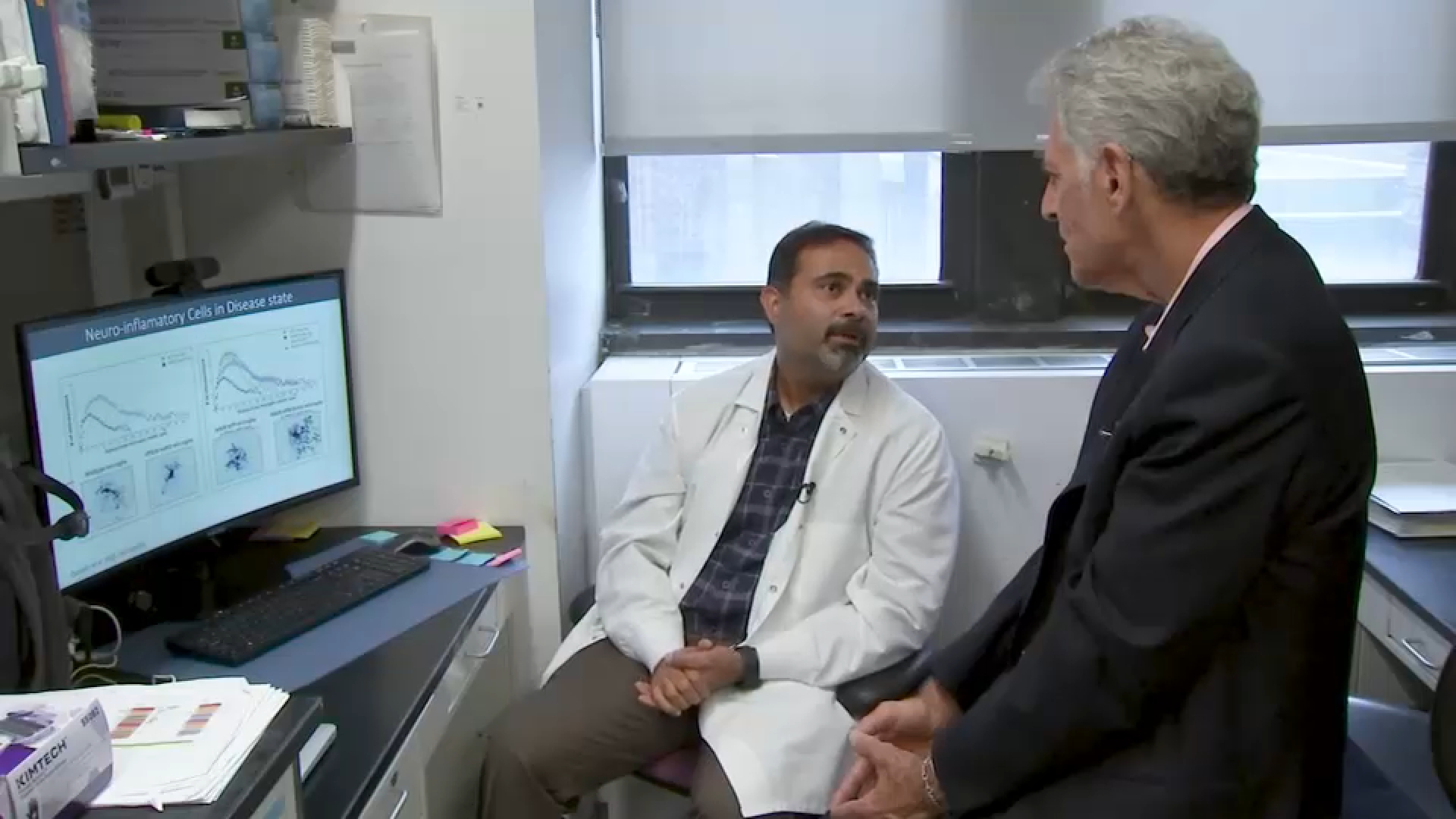
That brings us to Small's colleague, Dr. Yasir Qureshi, who works with the brains of both mice and postmortem Alzheimer's patients -- analyzing similar abnormalities.
"We can design questions based on the mouse studies, and then we can test them in those human brains, similar sections from similar areas that are representative," Qureshi said. "And if whatever we found in mice, does it translate to humans."
Replicating is one thing; reversing - or, as Qureshi says, "rescuing" - is quite another.
"We were able to see that after expression, we were able to rescue this type of process present in the normal self," Qureshi said.
This gave Qureshi the idea that if you could do it with mice, you could do it with people.
"The next steps are if this works, we'll do many more studies in academia first and then collaboration with industry to see if this can actually be developed into a drug," Qureshi said.
Taken together, the research has Small convinced a breakthrough is close.
"The home run will be hit, I'm sure of it," Small said. "It may be two years, it may be five years, but we're on the cusp."
Find and watch more Living with Alzheimer's stories here.
----------
* Get Eyewitness News Delivered
* Download the abc7NY app for breaking news alerts
* Download our connected TV app
Submit a tip or story idea to Eyewitness News
Have a breaking news tip or an idea for a story we should cover? Send it to Eyewitness News using the form below. If attaching a video or photo, terms of use apply.