Blind comedian helps make film industry accessible to all

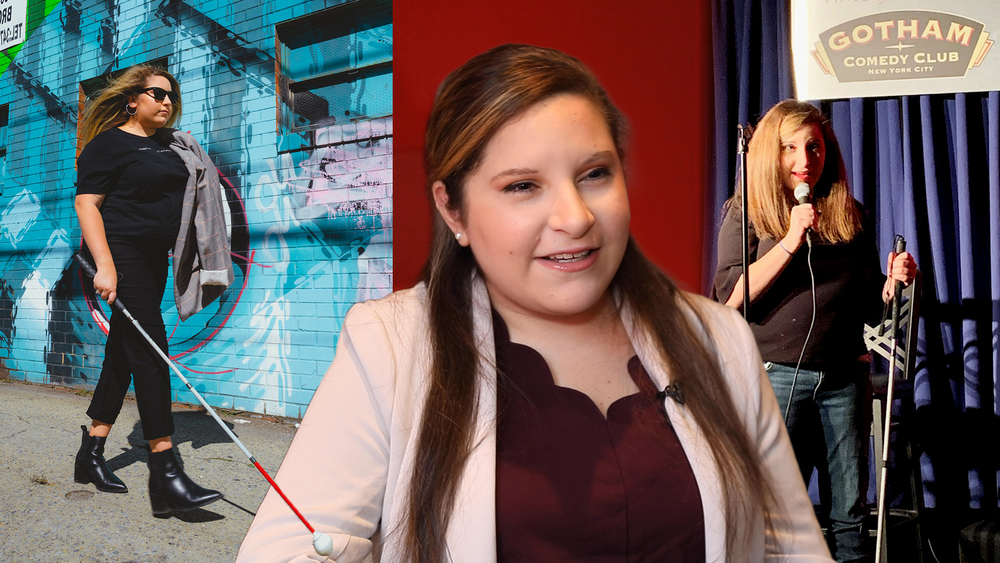
New York -- Zoe Hartman sees things differently.
"Imagine looking through a peephole at a staticky TV that's underwater. That's how I see the world now." Hartman said.
Hartman, 31, is legally blind. Eight years ago she woke up with blurry double vision. As her sight deteriorated, she was eventually diagnosed with a rare brain cancer. Hartman took her diagnosis head-on. She underwent surgery and chemotherapy and now has the cancer under control. But her path to healing was no ordinary journey.
"Something that I didn't expect to happen when I lost my eyesight is that I would actually be able to get around. I live in New York City. I can get anywhere I want to independently."
One big surprise Hartman has experienced is how New Yorkers react to her blindness.
"The funniest thing that's I've seen in reaction to people knowing that I'm blind is, I'm literally crossing the street and people will run up to me and say 'what is that, what happened?' I proceeded to tell them that I was visually impaired and they're like 'Oh, OK. Want to go out sometimes?' I'm like, 'I'm spoken for, thank you'."
Hartman's fiance is also visually impaired but the couple's unique experience is just a small part of their love story.
"Honestly sometimes I forget to mention that's he's visually impaired, because I just don't think about it. I think about the amazing, wonderful, kind, funny man that I'm with. And he makes me happy."
As Hartman started to work through the magnitude of her diagnosis, she realized laughter would truly be the best medicine.
"I used comedy as a way to cope. I did do standup comedy. Just getting up there and saying things to make people laugh about what I'm going through, it just felt good."
Now Hartman plans to take her experience from the comedy stage to film. She's working with her mother, a New York casting director, on a script that hits close to home.
"I want to write something that shows people this is what it's really like. This is based on a true story."
While Hartman has big plans for the big screen, she's already making major changes in the entertainment industry. Her career as a production accessibility coordinator empowers her to make sure film and TV sets are safe and accessible for people with disabilities.
"By having film sets and TV sets be more accessible, it makes it a community. You sort of all work together to make things easier for the actor, the director, the crew. For example, if you work with somebody with a wheelchair you have ramps, you have wide walkways. That's really helpful for the crew to get heavy equipment in and out of places. If you have somebody that's visually impaired, you're more aware of what's going on. I really love my disabled film community."
Hartman has taken her mission for disability inclusion even further. She has spoken with the Mayor's Office of Media and Entertainment and the Mayor's Office of People with Disabilities about improving the film industry's inclusion of disabled workers and artists.
According to nyc.gov, there are almost 1 million people with disabilities living in New York City
"There's a crazy percentage of people who work in film in New York. And a crazy percentage of people with disabilities without jobs."
One aspect she is pushing to change is getting the Made in New York PA program to get rid of its driver's license requirement.
"Being a PA is a great segue into working in the industry because you really get the chance to learn everything. I was a PA before I lost my vision."
Hartman is also working with the city on improving Access-A-Ride, the service that provides public transportation for disabled people in New York. It's a lifeline for many people but has a history of late pickups, which can cause riders to miss appointments and jeopardize their employment.
"If you're somebody with a disability you've worked so hard to get a job and now you want to make sure you're there on time. I think if Access-A-Ride had a few more resources it could be an even better service."
By calling attention to the needs and rights of people with disabilities, Hartman hopes real change will be permanent. She's blasting antiquated ideas that hiring disabled people would be a pain rather than a benefit.
"People with disabilities may not be able to do certain things, but they can find a way around it. I can't drive a car, but I can walk, I can take the subway, I can call an Uber. I may not be able to read a book, but I can listen to an audiobook. I'm not disabled. I'm differently abled."